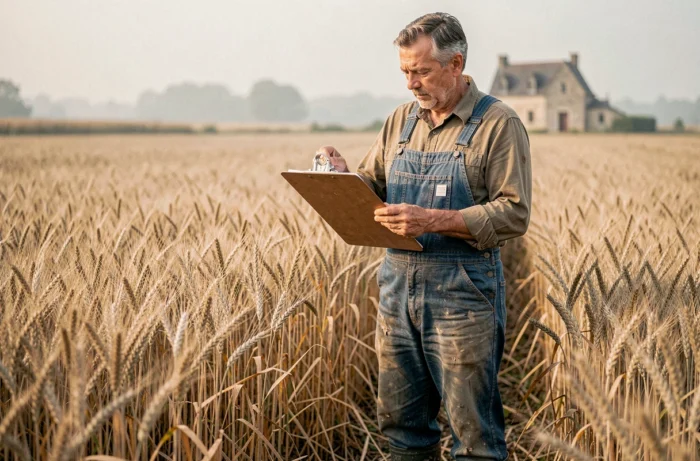
On a grain farm, a couple of farmers works full-time all year round. Their neighbor, a market gardener, employs three seasonal workers for six months a year and one permanent employee. How can we compare the workforce mobilized by these two very different farms? This is precisely the role of the UTH, the unit of human work, an indicator that brings all agricultural labor to a single scale of measurement.
The UTH corresponds to the work of one person employed full-time on a farm for an entire year. A part-time employee counts as 0.5 UTH. A seasonal worker present for three months represents about 0.25 UTH. This simple principle allows for the comparison of structures with very varied labor profiles.
UTH and legal status: what the measurement really captures
When we talk about UTH, we distinguish two main categories. The first includes non-salaried UTH: operators, collaborating spouses, family helpers. The second groups salaried UTH: permanent contracts, fixed-term contracts, seasonal workers, apprentices. This separation is not trivial.
It conditions access to certain public aids. In the context of aid for the recovery of agricultural operations, the available income per non-salaried UTH is among the eligibility criteria, as reported by La Volonté Paysanne in July 2026. Therefore, the UTH is not just a statistical tool: it is a concrete financial lever.
To deepen the definition of UTH in agriculture, it is also important to understand that the measurement does not take into account the physical intensity of the work or the qualifications required. A qualified vineyard worker and a versatile employee each count as one UTH if they work full-time.
Thresholds for salaried UTH and recent regulatory developments
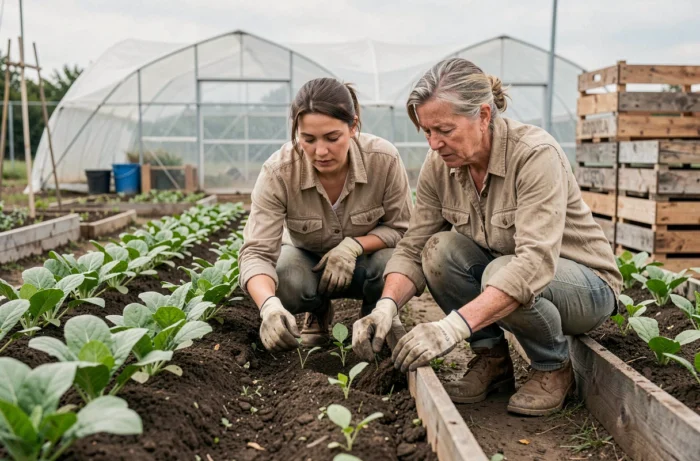
French farms have long been designed around the family model of two UTH: a couple, sometimes with a retired parent providing support. This model remains common, but it now coexists with larger structures that are heavily dependent on salaried labor.
Recent regulatory developments take this into account. According to La Volonté Paysanne (July 2026), the ceiling for salaried labor for certain aids has increased from 10 to 50 full-time equivalents (FTE). This increase means that farms employing several dozen workers can now qualify for support mechanisms previously reserved for smaller structures.
This change reflects an economic reality. In market gardening, fruit growing, or viticulture sectors, salaried labor far exceeds that of the family core. Excluding these farms from aid mechanisms would mean ignoring an increasing share of French agricultural production.
Why this threshold matters for farm management
Are you managing a farm with about fifteen permanent employees? Before this increase, you could have been considered too large to benefit from certain audits or recovery aids. The new threshold expands the scope without changing how UTH itself is calculated.
The calculation remains the same: each full-time employee counts as one UTH, and each part-time position is prorated. What changes is the perception of the administration regarding employing farms.
UTH and the common agricultural policy: an indicator at the heart of CAP aids
The CAP uses UTH (or its European equivalent, UTA, annual work unit) to calibrate several programs. Installation aids, support for young farmers, and certain measures from the second pillar incorporate the labor dimension into their allocation criteria.
UTH allows for relating agricultural income to the amount of labor mobilized. A farm generating good revenue but employing a lot of labor may show a low income per UTH, making it eligible for additional support.
- Installation aids assess the viability of the project based on the projected income per non-salaried UTH.
- The recovery aid includes the available income per UTH as a criterion for economic distress.
- Some agri-environmental measures relate the additional workload to UTH to estimate the compensation due to the farmer.
In summary, UTH connects the human dimension of work to the financial mechanisms of the CAP. Without this indicator, aids would be calibrated solely on area or revenue, which would favor highly mechanized farms at the expense of labor-intensive structures.

Limits of UTH: what the indicator does not measure
UTH quantifies a volume of work, not its nature. It does not distinguish between hours spent driving a tractor and those dedicated to administrative management or direct sales. On a diversified farm (farm visits, processing, short circuits), a significant portion of time escapes strict agricultural production but is still counted in UTH.
Another blind spot: the difficulty of work. Two farms each showing three UTH may offer radically different working conditions. One may rely on mechanized tasks, while the other depends on manual harvesting in greenhouses. UTH does not say anything about the quality of work or the social sustainability of a model.
- The indicator ignores fine seasonality: a seasonal worker present for three months can be counted the same way whether they work in the height of summer or in winter, even though the physical load differs.
- It does not capture informal volunteer work (neighborly help, unreported family assistance), which is common in small farms.
- It does not reflect the level of skill mobilized, which raises questions when comparing very technical sectors (precision viticulture) to more standardized productions.
These limits do not undermine the usefulness of UTH. They remind us that this indicator functions like a thermometer: it provides a reliable measure of the quantity of work, but other tools are needed to assess the overall health of a farm.
Despite its imperfections, UTH remains the reference shared by agricultural chambers, INSEE, MSA, and European organizations. Its strength lies in its simplicity: one unit, one person, one year. It is this clarity that allows it to endure successive reforms of agricultural policy and remain at the center of management and funding decisions.