A quadrilateral with four different sides does not correspond to any standard geometric shape. Neither rectangle, nor rhombus, nor regular trapezoid: the surface area calculation in m2 with 4 different sides requires breaking down the figure into simpler shapes for which we know the formulas. The method relies on a piece of information often overlooked: the internal diagonal, without which no reliable calculation is possible.
Why the diagonal conditions the entire surface area calculation
Four side lengths are not enough to define a unique shape. Two quadrilaterals can have exactly the same sides but very different areas because their angles differ. The variable that fixes the geometry is the diagonal.
By drawing a diagonal from one vertex to the opposite vertex, the quadrilateral is divided into two triangles. Each triangle then has three measurable sides, allowing us to apply Heron’s formula to obtain its area. The sum of the two areas gives the total surface area.
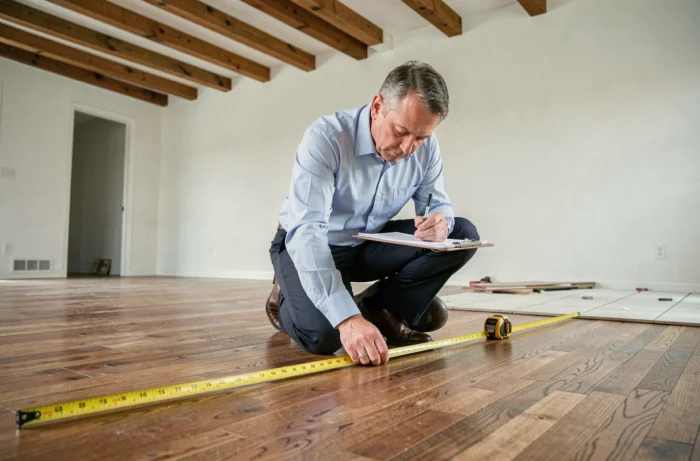
Mastering the surface area calculation in m2 with 4 different sides therefore starts with a physical measurement of this diagonal, using a tape measure or laser rangefinder.
For a concave quadrilateral (a “hollow” shape where an inward angle exceeds 180°), it is essential to choose the diagonal that remains inside the figure. Taking the other would completely distort the result.
Heron’s formula applied to an irregular quadrilateral

The Heron’s formula calculates the area of a triangle based on its three sides, without needing to measure an angle or height. For a triangle with sides a, b, and c, we first calculate the semi-perimeter s = (a + b + c) / 2. The area then equals the square root of s(s – a)(s – b)(s – c).
Step-by-step application
Let’s take a quadrilateral ABCD with sides AB, BC, CD, and DA, with the diagonal AC measured. This gives us two triangles: ABC (sides AB, BC, AC) and ACD (sides AC, CD, DA).
- Calculate the semi-perimeter of the first triangle: s1 = (AB + BC + AC) / 2, then its area using Heron’s formula.
- Calculate the semi-perimeter of the second triangle: s2 = (AC + CD + DA) / 2, then its area in the same way.
- Add the two areas to obtain the total surface area of the quadrilateral in m2.
This method works for any four-sided shape, whether convex or concave, as long as the choice of diagonal mentioned above is respected.
Common errors that distort the result
The first error consists of multiplying two adjacent sides as for a rectangle. In an irregular quadrilateral, this shortcut can produce a discrepancy of several m2, enough to change a tiling or painting estimate.
The second error concerns the units. All measurements must be converted to meters before the calculation, not after. Mixing centimeters and meters in Heron’s formula gives an inconsistent result without an alert message.
Living area and Carrez law: ceiling height changes the game
Calculating the geometric area of a room is not always sufficient. In the French real estate context, the Carrez law (for sales in co-ownership) and the Boutin law (for rentals) require counting only the part of the floor where the ceiling height reaches at least 1.80 m.

A room with a sloped ceiling and four irregular sides can therefore have a floor area greater than its legal surface area. Areas under slopes below the 1.80 m threshold must be excluded from the calculation.
Method for sloped rooms
The approach involves marking on the floor the line where the ceiling reaches exactly 1.80 m. This line creates a new boundary that divides the room into two zones: the countable part and the excluded part.
The countable area often forms a quadrilateral or an irregular pentagon, which is again broken down into triangles to apply Heron’s formula. Real estate diagnosticians use this same triangulation technique, sometimes assisted by a laser rangefinder that speeds up the measurements.
Excluding areas below 1.80 m can significantly reduce the declared surface area, which directly impacts the sale price or the calculation of rent.
Digital tools to verify an irregular surface area calculation
Several online calculators allow you to enter the four sides and one diagonal to obtain the area instantly. These tools apply Heron’s formula in the background and reduce the risk of manual calculation errors.
- Specialized geometric calculators require the five measurements (four sides + one diagonal) and display the result in m2.
- Smartphone measurement applications use the camera or LiDAR to capture distances, then automatically calculate the area.
- Plan software (like interior design applications) allows you to draw the room point by point and extracts the surface area of the drawn polygon.
These tools remain verifications. For an official document (Carrez diagnosis, building permit), the measurement must be carried out by a certified professional whose responsibility is engaged regarding the measurement.
The calculation of an irregular quadrilateral always boils down to the same principle: measure a diagonal, break it down into triangles, apply Heron. The difficulty is not mathematical; it is practical: taking reliable measurements on-site remains the step that determines the final accuracy of the result.