
The Google garden gnome doodle is an interactive mini-game integrated directly into the homepage of the search engine. Launched on the occasion of Garden Day in Germany, it allows players to catapult a ceramic gnome across a garden to make flowers bloom. This format, called interactive doodle, transforms the usual Google logo into a playable experience without installation or download.
Game mechanics of the garden gnome doodle: catapult and trajectory
The principle is based on a gnome launcher (a garden catapult). The player adjusts the angle and power of the throw, then releases to launch the gnome into the air. Each bounce on the ground makes flowers bloom around the point of impact.
The trajectory follows a simplified ballistic curve. The higher the angle, the higher the gnome goes, but the less horizontal distance it covers. The final score depends on the area of the garden covered with flowers, not just the distance.
Among Google’s interactive doodles, this one stands out for its purely physical mechanics. No quizzes, no puzzles: everything relies on the precision of the action. This choice makes it more akin to an arcade skill game than an educational game, and that’s what makes the Google garden gnome doodle game so addictive for a few minutes.

Garden gnome and German culture: why Google chose this symbol
The choice of the garden gnome as the doodle subject is not trivial. In Germany, the Gartenzwerg (garden gnome) is a cultural object in its own right, linked for centuries to the local gardening tradition. These terracotta or resin figurines embody a form of domestic relationship with nature, between symbolic protection of the vegetable garden and popular decoration.
Google published this doodle to coincide with Garden Day in Germany, an event that celebrates amateur gardening and community green spaces. The garden gnome is treated as a playful emblem of this culture, not just a simple kitsch trinket.
This connection between the doodle and the German gardening tradition is rarely highlighted in French-language articles, which focus on the entertaining aspect of the game. The cultural context of the Gartenzwerg gives the doodle a dimension that most players are unaware of.
Playing the garden gnome doodle with children: digital hygiene and best practices
The doodle contains no inappropriate content. The risk does not come from the game itself, but from the browsing environment around it: Google search bar, automatic suggestions, links to other doodles or web pages.
To frame a gaming session with children, a few concrete precautions make a difference:
- Prefer a tablet or computer rather than a smartphone, as the aiming area of the catapult is too small on a phone screen for children’s hands
- Limit sessions to three rounds of about ten minutes, with role rotation if multiple children are playing, to avoid eye strain and maintain enjoyment
- Use a child profile or guest mode in Chrome to prevent free browsing after the game, and refocus browser use as soon as the game is over
This approach allows enjoying the doodle as a temporary playful tool without opening the door to unsupervised browsing. The game then becomes an excuse for a shared moment, not a gateway to hours of screen time.
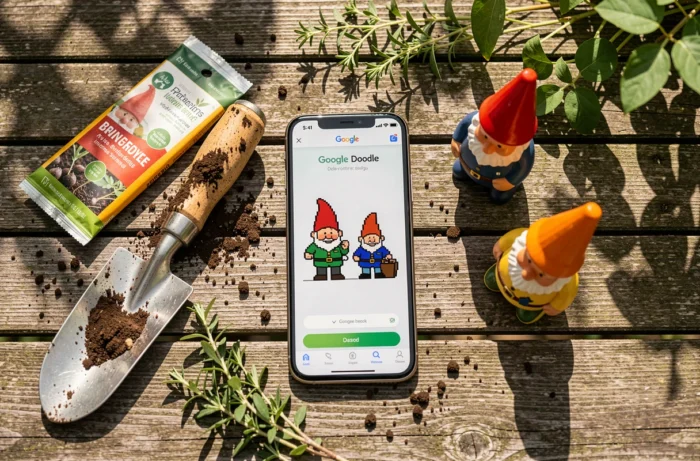
Google garden gnome doodle: access and longevity of the game
Google’s interactive doodles are only visible on the homepage during the day of their publication. Once this window has passed, they join the official Google Doodles archives, accessible from Google’s dedicated site.
The garden gnome doodle gained renewed visibility when Google reactivated it during the lockdown period, offering a light and accessible distraction for everyone without any installation. This temporary reactivation confirmed the game’s popularity with a much broader audience than just gardening enthusiasts.
Finding the doodle after its publication
To play it today, simply search for “Celebrating Garden Gnomes” in the Google Doodles archives or directly in the search engine. The game launches in the browser, on any device with an internet connection.
Unlike mobile apps inspired by the concept (like Garden Gnome on Google Play, developed by a third-party studio), the original doodle remains free, ad-free, and without user data collection beyond what Google already operates via its search engine.
The garden gnome doodle remains one of the few Google games that functions just as well years after its release as it did on the first day. Its simple mechanics, total lack of monetization, and connection to a real gardening tradition give it a longevity that most online mini-games do not achieve.