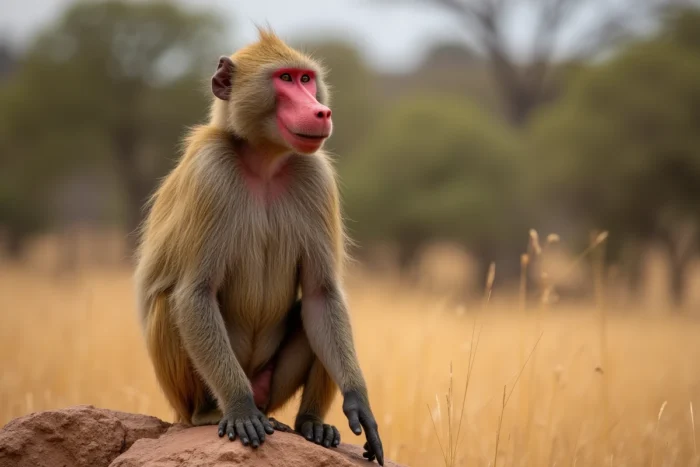
In baboons, the ano-genital area exhibits a bright red coloration produced by a strong subcutaneous vascularization. This perineal swelling varies in size and intensity according to hormonal cycles, social status, and even the health condition of the animal. Primatologists see it as a condensed set of overlapping biological signals, making it a much richer object of study than a simple fertility marker.
This coloration concerns several species of the genus Papio, as well as macaques and mandrills. The underlying mechanisms differ from one species to another, and it is precisely this diversity that fuels comparative research in evolutionary biology.
Vascularization and hormones: the physiological mechanism of the red color
The red of the baboon’s buttocks is not a pigment in the classical sense. It results from a dense network of blood capillaries located just beneath the epidermis, in an area devoid of fur. Estrogens stimulate vasodilation and cause an influx of blood that makes the skin swollen and scarlet.
In females, the intensity of the red fluctuates throughout the ovarian cycle. The swelling reaches its peak around the ovulation period, then regresses. This direct link between estrogen levels and coloration makes the perineal swelling a hormonal signal that can be read from a distance by conspecifics.
To delve deeper into the function and utility of this trait, a detailed article explains how the red buttock of the baboon reflects several simultaneous biological parameters.
Males also exhibit a red coloration, less spectacular but correlated with testosterone levels. In the hamadryas baboon, for example, dominant males display a redder facial and perineal skin than subordinates, suggesting a role in rank communication.
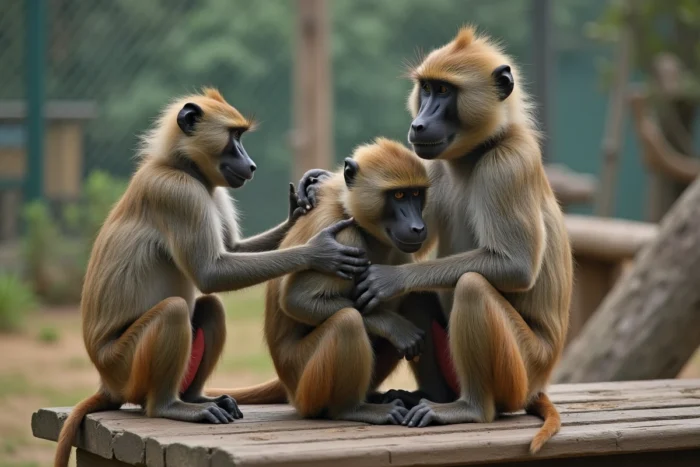
Fertility signal or immune indicator: what recent research explores
The classical interpretation of perineal swelling is summarized as a fertility signal directed at males. This explanation remains valid, but it only covers part of the phenomenon. Recent work expands the interpretation towards the immunological dimension.
The hypothesis is as follows: the red coloration would also reflect the parasitic load and the immune competence of the individual. A healthy animal, capable of maintaining strong cutaneous vascularization despite infections, would display a more intense red. The signal would then become an honest indicator of genetic quality, in the sense that it is costly to produce for a weakened organism.
This type of signal, which biologists call a handicap in the sense of Zahavi, interests researchers because it could serve as a model to understand how sexual selection exploits health indicators in other vertebrates. The red buttocks of baboons would thus constitute a non-invasive proxy to assess the health status of a population during field monitoring.
A multidimensional signal
The information coded in the perineal coloration overlaps:
- The stage of the ovarian cycle, which informs males about the female’s fertility window
- The overall hormonal status, related to social rank and the animal’s stress level
- The immune competence, perceptible through the quality and consistency of cutaneous vascularization
This overlap makes perineal swelling a multidimensional signal rare among mammals, which explains the ongoing interest of primatologists.
Color plasticity: rapid variations related to stress and temperature
Beyond genetics and the hormonal cycle, the intensity of the red varies in the short term. Ambient temperature plays a direct role: vasodilation increases in warm weather, making the coloration more pronounced. Conversely, cold causes vasoconstriction that diminishes the red.
Social stress also alters the color. A baboon facing a hierarchical conflict or a predation situation experiences a redistribution of blood flow to the muscles, at the expense of the perineal skin. The color pales within minutes under the effect of cortisol, then returns to its baseline level once the stress has passed.
This rapid plasticity transforms the coloration into an almost instantaneous communication channel. Conspecifics can assess the emotional state of an individual without physical contact, simply by observing the chromatic variations of its perineal area.
Skin coloration in primates: a model for evolutionary biology
Primates constitute the most colorful group of mammals. Reds, blues, purples: skin hues vary considerably from one species to another. The mandrill sports a blue and red face, the gelada displays a scarlet chest patch, and Japanese macaques have a red face whose intensity varies with the breeding season.
This diversity allows researchers to conduct comparative studies to determine which evolutionary factors promote the emergence and maintenance of bright colorations:
- The pressure of sexual selection, which favors exuberant visual signals when females actively choose their mates
- The visual ecology of the environment, as a red signal is detected differently in dense forest versus open savanna
- The social structure of the group, since species with strict hierarchy tend to develop more pronounced visual rank markers
The baboon, with its variable and measurable perineal swelling, offers an accessible experimental model to test these hypotheses. Field observations can be complemented by standardized colorimetric analyses from calibrated photographs.
Increasingly refined measurement tools
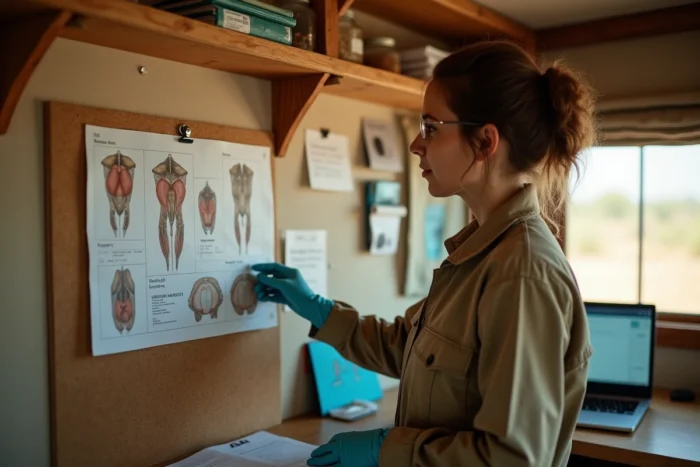
Advances in digital imaging now allow for quantifying color variations with a precision that the human eye cannot achieve. Researchers use portable spectrophotometers and colorimetric analysis software to track fluctuations in red over the days, correlated with hormonal and behavioral data collected in parallel.
The perineal swelling of the baboon remains an active research area because it concentrates, in a single morphological trait, questions that traverse reproductive biology, immunology, behavioral ecology, and signaling theory. Few anatomical traits in mammals offer such a density of information that can be exploited from a distance and without invasive sampling.