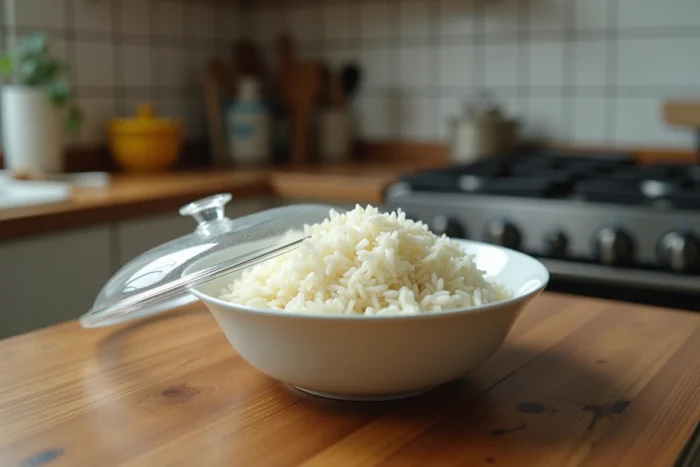
The cantonese rice syndrome refers to a food poisoning caused by the bacterium Bacillus cereus. In the United States, this bacterium is responsible for over 63,000 cases of food poisoning each year, a volume that makes it a common cause, yet its severity remains poorly understood by the general public.
Emetic syndrome and diarrheal syndrome: two distinct clinical pictures
Microbiology distinguishes two different syndromes related to Bacillus cereus, each involving a specific toxin and mechanism.
| Criterion | Emetic syndrome | Diarrheal syndrome |
|---|---|---|
| Involved toxin | Cereulide (preformed in the food) | Enterotoxins (produced in the intestine) |
| Onset time | Rapid (a few hours) | Later |
| Dominant symptoms | Nausea, vomiting | Watery diarrhea, abdominal pain |
| Typical foods | Rice, pasta, starchy foods left at room temperature | Meats, sauces, vegetables |
| Potential severity | Rare but documented fatal cases | Generally mild |
The emetic syndrome is the one associated with reheated rice. The cereulide toxin forms directly in the food while it remains at room temperature. It is resistant to cooking: reheating the dish does not eliminate it.
An article that circulated widely describes the cantonese rice syndrome on L’Art du Goût, reminding that the well-publicized case involved a 20-year-old Belgian student who died after consuming pasta stored for several days at room temperature. The death remains an extreme case, but it illustrates the specific danger of cereulide.

Bacillus cereus in rice: why this food poses a specific problem
Bacillus cereus produces heat-resistant spores. Cooking rice kills the vegetative forms of the bacterium, but the spores survive. Once the rice cools down to the favorable temperature zone (between about 10 °C and 50 °C), the spores germinate and the bacterium multiplies.
Cooked rice provides a moist, starchy, and slightly acidic environment. These conditions are ideal for rapid proliferation. The cereulide toxin then accumulates in the rice, and no reheating can destroy it once formed.
The name “cantonese rice syndrome” is misleading in one respect: the problem does not come from the cantonese rice as a recipe, but from any starchy food left out of the refrigerator for too long. Pasta, semolina, and mashed potatoes present the same risk.
Recommendations from Anses for storing cooked starchy foods
Anses (French Agency for Food, Environmental and Occupational Health & Safety) has issued specific recommendations on storing food leftovers. They directly target the mechanism of proliferation of Bacillus cereus.
- Refrigerate leftovers within two hours after cooking. This time frame is the threshold beyond which bacterial multiplication accelerates significantly.
- Divide large quantities into smaller, shallower portions to speed up cooling. A bowl full of rice in the center of the countertop takes much longer to cool down than a thin layer spread out in a dish.
- Never leave a cooked dish to cool at room temperature overnight, even in winter. The indoor temperature of a home is sufficient to allow spore germination.
- Consume refrigerated leftovers within a short time and do not reheat them multiple times.
These rules do not only apply to rice. Anses extends them to all cooked dishes. The difference with other pathogenic bacteria (Salmonella, Listeria) is that reheating does not protect against cereulide that has already formed.

Bacillus cereus poisoning: severe cases and statistical reality
The case of the Belgian student, documented in the medical literature, has given the cantonese rice syndrome a disproportionate notoriety compared to its actual frequency in severe form. The vast majority of Bacillus cereus poisonings resolve spontaneously within a few hours with moderate digestive symptoms.
Fatal cases remain documented in isolation in the medical literature. They generally involve prolonged storage at room temperature (several days, not just a few hours) and sometimes a compromised health condition.
This disproportion between media coverage and statistical reality fuels a double effect. On one hand, an excessive fear of reheated rice. On the other, an underestimation of the real risk posed by other starchy foods like pasta or semolina, which are affected by the same bacterial mechanism.
What distinguishes a real risk from unfounded panic
The risk is real when a cooked starchy food remains at room temperature for more than two hours. It becomes significant after several hours, and potentially dangerous after an entire night or more.
On the other hand, properly refrigerated rice that is then reheated does not pose any particular danger. The fear of reheating rice “in all cases” is a myth. The determining factor is not reheating, but the duration spent in the critical temperature zone before cooling.
Thus, the cantonese rice syndrome is neither a complete myth nor the systematic threat that some content suggests. The biological mechanism is well documented, severe cases exist, and prevention relies on the rapid refrigeration of leftovers, ideally within two hours after cooking.