
Oxalis is a perennial plant that colonizes gardens with formidable efficiency. Its tiny bulbs, buried in the first few centimeters of soil, allow it to regenerate after each attempt to uproot it. Before trying to eliminate it, one must understand why conventional methods often fail and adapt their strategy to the very particular mode of reproduction of this weed.
Why digging worsens oxalis infestation
The most common reflex when faced with an oxalis invasion is to turn the soil deeply, using a tiller or a spade. Feedback from amateur gardeners converges on one point: aggressive soil work multiplies oxalis hotspots. Each pass of the tool fragments the bulbs and bulbils, which disperse throughout the plot and generate new plants.
This mechanism explains the frustration of many gardeners who see oxalis return denser after autumn digging. The plant precisely exploits this fragmentation to spread, somewhat like couch grass with its rhizomes, but on an even finer scale since the bulbils measure only a few millimeters.
For those looking for how to effectively get rid of oxalis, the first rule is to limit deep mechanical interventions in infested areas as much as possible. Manual uprooting is still possible, but only on the surface, with care, to extract the clumps without bursting the bulbils in the surrounding soil.
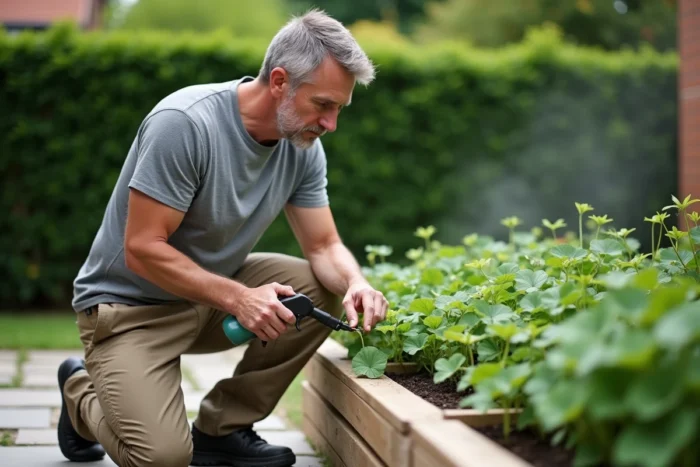
Thick mulching and tarping: smothering oxalis without chemicals
Depriving oxalis of light remains the most reliable method in the medium term. Two approaches stand out depending on the condition of the land.
Heavy mulching on flowerbeds and vegetable gardens
A dense organic mulch (dead leaves, wood chips, straw) laid down to a sufficient thickness prevents the emergence of young shoots. The mulch must cover the soil without gaps to be effective, as oxalis exploits any opening to emerge.
This mulch has a collateral advantage: it retains soil moisture and nourishes microbial life, which benefits the existing crops. However, it does not destroy the bulbils already present deep in the soil. Therefore, the covering must be renewed each season for at least two to three years to gradually deplete the stock of bulbils.
Opaque tarping for free areas
On an uncultivated plot, an opaque tarp (woven fabric or black plastic) laid down for several months yields better results. The complete absence of light for an entire season seriously weakens the plant. The bulbils eventually consume their reserves without being able to regenerate foliage.
This technique requires patience. A tarp removed too early restarts the cycle, as the deepest bulbils retain a prolonged dormancy capacity. Field reports vary on the necessary duration: some gardeners see results after four months, while others notice regrowth the following year.
White vinegar and boiling water on oxalis: real limits
Two natural remedies appear in most guides: white vinegar sprayed on the foliage and boiling water poured at the base of the clumps. These methods destroy the aerial part of the oxalis, but their effect on the underground bulbils remains very limited.
- White vinegar burns the leaves on contact and causes rapid drying. It does not reach the bulbils located a few centimeters underground, which regrow as soon as conditions become favorable again.
- Boiling water penetrates slightly deeper and can damage the superficial roots. It also kills the soil microfauna in the treated area, making it unsuitable for planted flowerbeds or vegetable gardens.
- Both methods only work with repeated treatments, every two to three weeks, to gradually deplete the plant. Used just once, they yield a cosmetic result without lasting effect.
Vinegar also alters the soil pH with frequent applications. In an already acidic soil, this effect can disturb neighboring plantings. It is better to reserve this method for paths, paving, and uncultivated areas.
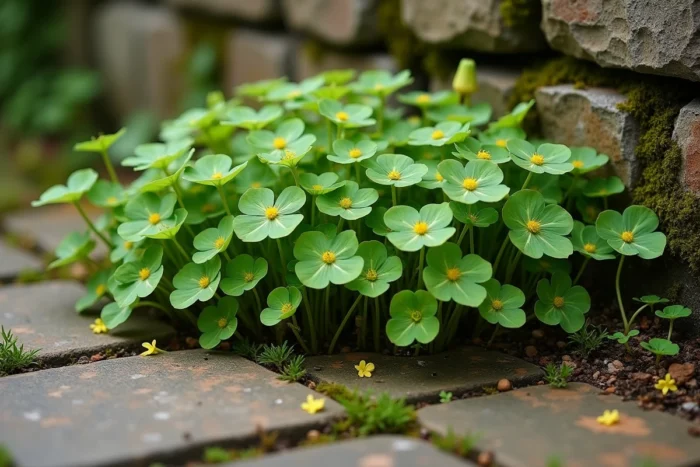
Oxalis in lawns: should it really be eliminated?
This question is worth asking, as the perception of this plant is evolving. Several French municipalities have stopped fighting oxalis in public spaces, following the “zero pesticide” policies stemming from the Labbé law and its extensions. Green space services now tolerate its presence in lawns and at the base of trees, in the name of reducing inputs and maintaining biodiversity.
Naturalist gardeners even incorporate certain spontaneous oxalis species (notably Oxalis corniculata) into mixes for flowering lawns or urban meadows. Oxalis remains green under high heat and provides nectar to pollinators, two qualities appreciated in the context of repeated heat waves.
This evolution obviously does not apply to vegetable gardens, where oxalis competes directly with crops for light and nutrients. But in a lawn or a less demanding ornamental space, tolerating oxalis rather than exhausting oneself trying to eradicate it is an increasingly advocated option by practitioners of ecological gardening.
Combined strategy against oxalis: the actions that matter
No single method can eliminate an established infestation. The most effective approach combines several levers over time:
- Superficial uprooting of visible clumps, without turning the soil, to limit the dispersion of bulbils.
- Thick and continuous mulching in treated areas, renewed each season, to prevent regrowth.
- Tarping of free plots for several months to deplete underground reserves.
- Planting vigorous ground covers (white clover, phacelia, mustard) that compete with oxalis by occupying space and light at ground level.
Complete elimination of oxalis generally takes several seasons. Gardeners who achieve the best results are those who accept this timeline and maintain constant pressure, season after season, without resorting to deep soil work that restarts the multiplication cycle.
Oxalis is not a fatality, but its management requires a patient and consistent approach. In some cases, learning to coexist with this plant remains the most realistic solution, especially when it occupies areas where it does not interfere with any crops.