
The mention “VIR DEBIT” on a La Banque Postale account statement refers to an outgoing transfer, meaning an amount debited from the client’s account to another bank account. This line item, often accompanied by a sometimes cryptic label, raises legitimate questions among account holders who do not always manage to identify the corresponding transaction.
Verification of the beneficiary and European regulation 2024/886: what changes concretely
The regulatory framework surrounding SEPA transfers has evolved significantly. The Regulation (EU) 2024/886 on instant euro transfers imposes new obligations on payment service providers, including La Banque Postale.
As of January 9, 2025, all institutions offering standard SEPA transfers must allow their customers to receive instant transfers. The obligation to issue instant transfers comes into effect on October 9, 2025.
The most concrete aspect for users concerns the verification of the beneficiary. Starting October 9, 2025, before executing a transfer (instant or standard), the bank must verify the match between the entered beneficiary’s name and the provided IBAN. In case of a discrepancy, a warning screen will appear.
To understand in detail how the debit transfer at La Banque Postale works, one must integrate this new layer of control that modifies the user experience during each outgoing transfer order.
This verification aims to reduce address errors and fraud through IBAN spoofing. Specifically, a customer entering an IBAN that does not match the declared recipient’s name will receive an alert before validation. The transfer is not automatically blocked, but the order giver is informed of the risk.

Instant transfer at La Banque Postale: pricing aligned with standard transfer
The same European regulation requires that instant transfers are not more expensive than ordinary SEPA transfers under comparable conditions. La Banque Postale can no longer apply a structural surcharge for an instant transfer compared to a standard transfer.
This point changes the trade-off that customers made between standard transfer (free in most account plans) and instant transfer (previously charged). The pricing alignment removes this gap and makes the instant transfer accessible without cost consideration.
Execution time and impact on the account statement
A standard SEPA transfer appears on the statement with a one business day delay. The instant transfer, on the other hand, is credited within seconds. On the order giver’s statement, the line “VIR DEBIT” appears in both cases, but the actual debit timing differs.
For transfers executed on a Friday evening or a public holiday, the standard transfer will only be processed on the next business day. The instant transfer, however, is executed regardless of business days, including weekends and public holidays.
Reading the account statement: decoding the VIR DEBIT line
The mention “VIR DEBIT” on a La Banque Postale statement generally consists of several elements:
- The type of operation (VIR for transfer, DEBIT for outflow of funds), sometimes followed by “SEPA” to specify the standard used
- The beneficiary’s label or an internal reference, often truncated to about twenty characters, complicating identification
- The value date, which may differ from the displayed transaction date, especially for transfers made at the end of the day
When a customer does not recognize a “VIR DEBIT” transaction, the first step is to check the details of the transaction in the online client area or on the mobile app. The full label of the beneficiary is included there, unlike the paper statement which truncates the information.
Permanent transfers and one-time transfers
Permanent transfers (rent, scheduled savings) generate recurring “VIR DEBIT” lines with the same label. A one-time transfer, on the other hand, appears only once. The distinction is not always visible on the statement: only the client area allows verification of whether a transfer is scheduled or isolated.
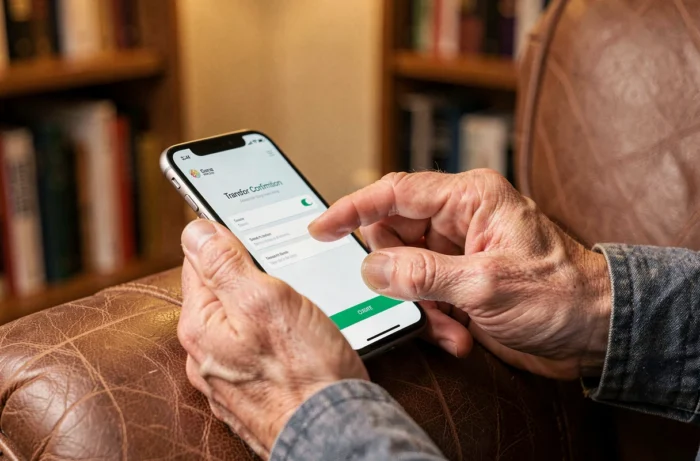
Disputing an unrecognized debit transfer at La Banque Postale
A SEPA transfer issued by the account holder is not revocable once executed. European regulation does not provide a right of withdrawal on an outgoing transfer, unlike the SEPA direct debit which benefits from a dispute period.
If a customer identifies a debit transfer that they did not order, the process involves a written complaint to La Banque Postale. The institution must then verify whether strong authentication was properly performed during the validation of the order.
- If strong authentication (Certicode Plus or equivalent) was not correctly performed, the bank is obliged to refund the customer unless there is gross negligence on their part
- If the authentication was validated by the customer, the burden of proof shifts and the refund is not automatic
- Filing a complaint is recommended in parallel, especially in cases of suspected fraud or phishing
Field reports vary on the processing times for these complaints. Some customers report resolutions within a few days, while others mention longer procedures requiring the intervention of the banking mediator.
Transfer limits and management from the client area
La Banque Postale applies transfer limits that vary according to the channel used (mobile app, web client area, counter) and the type of account. These limits can be modified from the client area, within certain limits set by the institution.
A transfer exceeding the authorized online limit requires either a temporary increase of the limit (possible via the app for certain plans) or a visit to the post office. This constraint explains why some significant transfers continue to go through the counter.
Managing registered beneficiaries is another point of attention. Adding a new beneficiary from the mobile app or website is subject to a security delay before the first transfer, usually a few hours. This delay aims to prevent fraud in case of compromise of account access.
The debit transfer at La Banque Postale remains a common operation, but the European regulatory strengthening is gradually changing the execution conditions. The systematic verification of the name-IBAN pair and the pricing alignment of instant transfers represent the two most structuring changes for customers on a daily basis.