The educational monitor occupies a unique place in social work: they intervene at the heart of the daily lives of the people they support, but their role goes far beyond animation or assistance with daily living tasks. Recent job offers outline a profile where coordination, traceability, and connection with families weigh as much as the direct educational relationship.
Understanding what this profession truly entails requires distinguishing between what falls under regulatory frameworks, institutional practices, and ongoing developments.
Educational Monitor and Specialized Educator: What Job Descriptions Really Distinguish
The confusion between these two professions persists because their missions overlap in the field. The official framework of the DEME (State Diploma of Educational Monitor) specifies that the educational monitor works under the responsibility of a more qualified social worker. This functional hierarchy has concrete consequences on the scope of intervention.
| Criterion | Educational Monitor | Specialized Educator |
|---|---|---|
| Required Diploma | DEME (high school level) | DEES (bachelor’s level) |
| Duration of Training | 2 years | 3 years |
| Autonomy of Diagnosis | Contributes to the personalized project | Designs and coordinates the educational project |
| Work with Families | Support, co-education, daily connection | Formal interviews, family mediation |
| Institutional Responsibility | Participates in the establishment project | Can lead a service project |
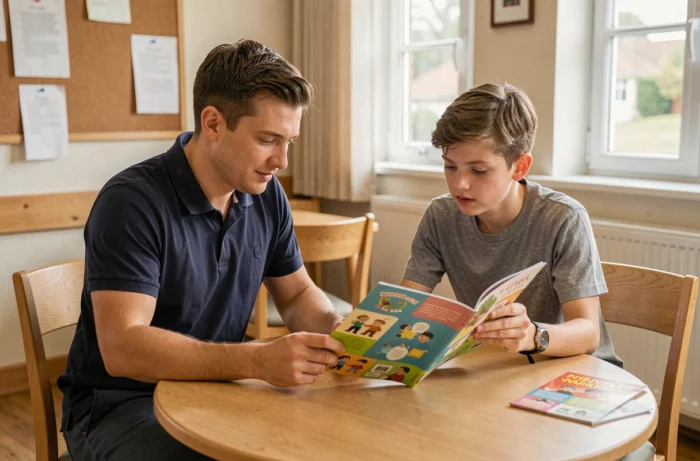
The difference is not in the quality of relationships but in the level of responsibility in designing the systems. An educational monitor working in a social children’s home (MECS) animates daily life and observes behaviors. The specialized educator, on the other hand, formalizes the educational diagnosis and coordinates external partners.
To delve deeper into the definition and missions of the educational monitor, one must look beyond this hierarchical distinction and examine how the position evolves in practice.
Coordination and Traceability: Missions That Job Descriptions Underestimate
Classic job descriptions emphasize daily support, activity animation, and socialization. These missions remain central, but current job offers reveal a shift towards coordination tasks that do not always appear in the reference frameworks.
Observation, written transmissions, and participation in team meetings now feature in the majority of announcements. The educational monitor no longer simply reports a behavior orally: they write activity reports, ensure traceability of actions taken, and contribute to the monitoring of personalized projects.
This administrative shift responds to a growing institutional requirement. Social and medico-social establishments must document every step of support, whether for external evaluations or for relations with funders. The educational monitor becomes a link in this documentary chain.
Working with Families: An Expanding Focus
Several recent job descriptions explicitly mention support for parental functions and co-education. This is not trivial. Historically, the educational monitor focused on the person being supported in the collective space of the establishment. Today, their scope extends to relatives.
In the child protection sector, this translates into regular exchange times with parents, participation in mediated visits, or a role as a relay between the family and the multi-professional team. The educational relationship is no longer built solely within the institution, but in a back-and-forth between the reception site and the family environment.
Supported Populations: A Diversity That Redefines the Position
The educational monitor works with children, adolescents, adults with disabilities, dependent elderly individuals, or populations facing social exclusion. This diversity is well-known. What is less recognized is the emergence of situations of double vulnerability that complicate support.
A concrete example: children placed in child protection establishments who also fall under a notification from the MDPH (Departmental House for Disabled Persons). The educational monitor must then articulate two logics, that of placement and that of disability, with different interlocutors, timelines, and legal frameworks.
- In MECS or children’s homes, the focus is on stabilizing daily life, maintaining family connections, and identifying specific educational needs.
- In medico-educational institutes (IME) or medicalized reception centers, the educational monitor works on functional autonomy and socialization, often in tandem with paramedical professionals.
- In social reintegration and accommodation centers (CHRS), the missions focus on integration, access to rights, and support towards independent housing.
This variety of contexts explains why adaptation and observation skills take precedence over technical specialization. The same diploma opens up radically different field realities.
Access to the Profession and Training Path of the Educational Monitor
The DEME is prepared in two years at accredited training institutions. Admission is through a selection process based on a file and interview, with no prior diploma requirement. The training alternates between theoretical teaching and practical internships, with the possibility of following the curriculum under an apprenticeship contract.
The path does not stop at the diploma. Pathways to the specialized educator diploma (DEES) allow for training reductions based on the acquired skills from the DEME. The validation of acquired experience (VAE) offers another route for professionals who have been in position for several years.
Professional Evolution and Perspectives
After a few years of practice, an educational monitor can move towards roles as a specialized educator, social and family intervention technician, or even coordination positions. The development of skills in project writing and partnership work constitutes a concrete lever for these evolutions.
The profession of educational monitor is transforming without changing its nature. The close educational relationship remains the foundation, but it is situated within a more demanding institutional framework regarding traceability, work with families, and support for populations with mixed profiles. It is this tension between daily life and the system that gives the position its real complexity.