Contacting an online wellness center remains an underestimated friction point. According to a business barometer published in August 2026 (FÉNA and Merci Solange data), a majority of wellness practitioners can only be reached by phone, email, or messaging. On the global market side, 71.82% of the revenue from professional beauty services still comes from offline bookings (walk-ins, phone calls, direct contact). Digital accelerates discovery and re-booking, but does not replace the initial contact. Which channels truly facilitate this step, and what gaps exist between the available tools?
Online contact channels: a comparison of options for a wellness center
Wellness centers have several digital channels to receive requests. Not all are equal in terms of availability, response speed, and workload for the team.
| Contact Channel | Availability | Average Response Time | Team Load |
|---|---|---|---|
| Web form (contact page) | 24/7 | Variable (hours to days) | Moderate (manual processing) |
| Online booking (Fresha, etc.) | 24/7 | Instant | Low (automated) |
| Social media messaging | 24/7 | Variable (minutes to hours) | High (manual follow-up) |
| Live chat / chatbot | Business hours or 24/7 | Instant to a few minutes | Variable (depending on automation) |
| Classic email | 24/7 | Hours to days | Moderate |
The web form and email remain the most common, but their response time entirely depends on human reactivity. In contrast, online booking platforms eliminate this wait by confirming the slot instantly. For a center looking to simplify the initial process, combining a clear web form with a direct booking module significantly reduces abandonment.
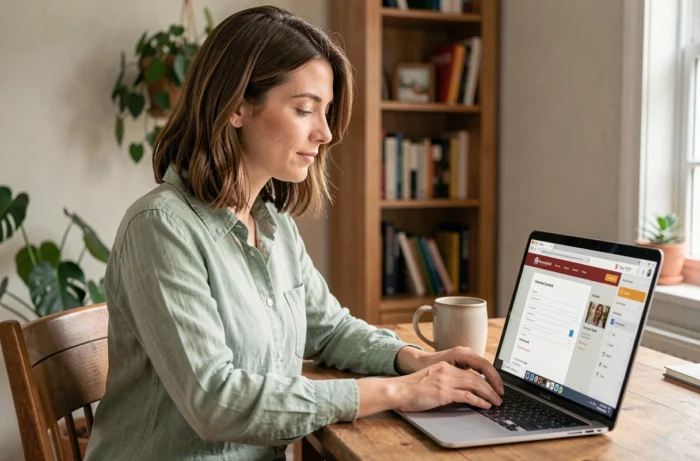
Contacting the Centre Du Logos website illustrates this approach: a dedicated page that centralizes information without forcing the visitor to search for a phone number or navigate between multiple tabs.
Contact page on a wellness website: elements that change the response rate
A poorly designed contact form generates as much frustration as a busy phone line. The difference between a converting page and an ignored page lies in a few concrete parameters.
Number of fields and completion rate
The more fields a form has, the higher the abandonment rate. A wellness center does not need to know the client’s postal address or date of birth at the first contact. Three to five fields are sufficient for an initial contact: name, email, subject of the request, message, and possibly a service choice.
Loading time and mobile display
The majority of local searches are conducted from a smartphone. If the contact page takes several seconds to load or if the form is not adapted to a touchscreen, the visitor leaves the site before typing a word. A WordPress site with an optimized theme and a native form (without heavy plugins) offers a good compromise between customization and performance.
Confirmation and announced timeframe
Displaying an estimated response time after submitting the form reduces uncertainty. A message like “We will respond within 24 hours” provides a framework. Without this indication, the client does not know whether to call back, resend an email, or wait.
Online booking for spas and wellness centers: what offline does not cover
The figure from the global barometer is telling: more than seven out of ten transactions still go through direct contact. Online booking platforms represent the fastest-growing segment of the market, but they are not intended to replace the phone or spontaneous visits. They cover a different need.
- Online booking captures clients looking for a slot outside of business hours, in the evening or on weekends, when no one is answering
- It facilitates re-booking for existing clients, who already know the services and simply want to block a slot without verbal exchange
- It reduces the volume of incoming calls for the reception team, allowing them to focus on in-person support and complex requests
Digital serves discovery and re-booking, not the total replacement of human contact. A center that installs an online booking module without maintaining quality phone support loses clients who need a personalized exchange before committing (choice of treatment, contraindications, questions about pricing).
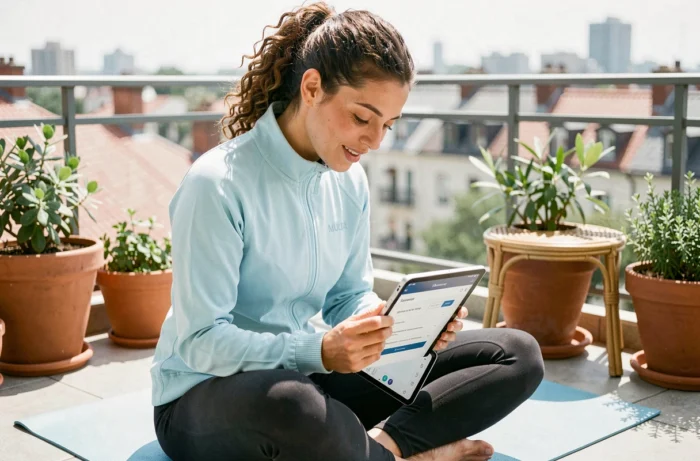
Instant messaging and social media: a contact channel to frame
Instagram and Facebook generate spontaneous inquiries via direct messaging. This channel has the advantage of being familiar to clients, but it poses a follow-up problem.
Messages received on social media do not automatically integrate into a client file or booking agenda. Each request must be processed manually, often by the same person managing the posts. Without a process for redirecting to the web form or booking module, requests get lost between two notifications.
Conversely, a chatbot integrated into the website can filter frequently asked questions (hours, pricing, availability) and direct the visitor to the right action: book online, call, or fill out the contact form. This automated sorting frees up time without eliminating the possibility of human interaction for cases that require it.
The choice of contact channel depends on the size of the team and the volume of requests. An independent practitioner does not have the same constraints as a spa with five treatment rooms and a dedicated receptionist. In both cases, centralizing requests on one or two main channels remains more effective than multiplying entry points without response capacity behind them. The contact page of the website, combined with a booking tool, covers the essential needs without dispersing the team’s attention.