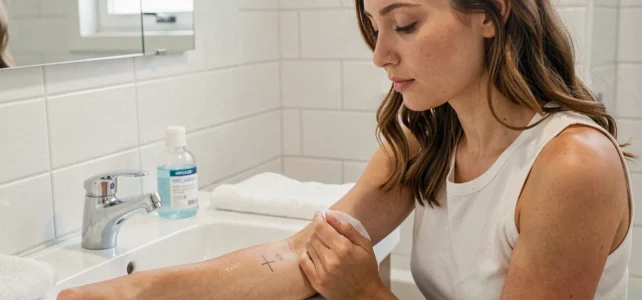
The tattoo stencil is a hectographic transfer applied to the skin to guide the tattoo artist’s drawing. Made of soluble purple or blue pigments, it adheres to the epidermis thanks to a transfer gel or a stick deodorant. Removing this transfer cleanly, without irritating the area, requires understanding the nature of the pigment and choosing the right solvent.
Composition of the hectographic pigment and skin reaction
The stencil inks used in tattooing are based on water-soluble hectographic dyes. Their formulation allows for temporary adhesion to the stratum corneum of the epidermis, the most superficial layer of the skin.
This partial solubility in water explains why a simple rinse is not always sufficient. The transfer gel creates a lipid film that fixes the pigment in the skin’s micro-reliefs. To dissolve this film, an agent capable of breaking down fats without damaging the skin barrier is needed.
Recent dermatological recommendations emphasize a often overlooked point: avoid any product containing alcohol, fragrance, or heavy oils on an area intended to be tattooed. These substances weaken the skin barrier and increase the risk of irritation, chemical burns, or pigmentation disorders. Knowing how to remove the tattoo stencil at home therefore starts with choosing a product suitable for the sensitivity of the area.
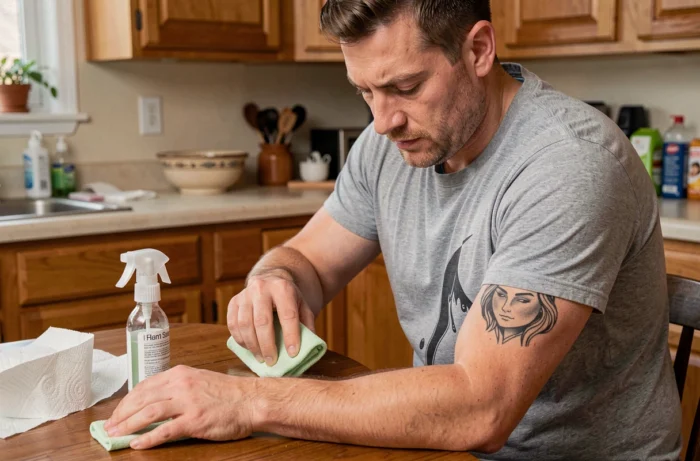
Solvents suitable for removing the tattoo stencil
Not all products are equal. The choice depends on the resistance of the transfer and the condition of the skin at the time of removal.
Coconut oil or baby oil
Neutral vegetable oils are the most skin-friendly solvent. Coconut oil, rich in fatty acids, or baby oil (fragrance-free liquid paraffin) dissolve the lipid film of the transfer gel through chemical affinity. The pigment gradually detaches without aggressive friction.
Apply a generous amount to the area, let it sit for a few minutes, then wipe with a cotton pad or sterile compress. Repeat if any purple residue remains in the skin folds.
Alcohol-free biphasic makeup remover
Makeup removers designed for waterproof makeup contain an oily phase and an aqueous phase. This dual action is effective against stubborn hectographic pigments. Check that the formula contains neither alcohol nor fragrance before using it on skin that will be tattooed.
Mild antibacterial soap and warm water
For a fresh stencil, mild antibacterial soap is sufficient in most cases. Warm water slightly opens the pores and facilitates the detachment of the pigment. This method is suitable for recent transfers that have not had time to set deeply.
- Coconut oil or baby oil: dissolves the lipid film, suitable for sensitive skin and resistant stencils.
- Alcohol-free biphasic makeup remover: dual water-oil action, effective on waterproof pigments.
- Mild antibacterial soap with warm water: sufficient for fresh transfers, the simplest method.
Technical gestures for complete removal without irritation
The product alone does not do everything. The application technique determines the result as much as the choice of solvent.
Apply the chosen product in light circular motions, without pressing. Pressure does not accelerate the dissolution of the pigment but causes micro-lesions on the stratum corneum. Use a sterile compress or a cotton pad, never a brush, an exfoliating glove, or a rough cloth.
If the stencil resists after two applications, add a layer of oil and let it sit for a few more minutes. Contact time is more effective than friction. This principle is particularly applicable to areas with thin skin (inside the arm, neck, ribs) where sensitivity is heightened.
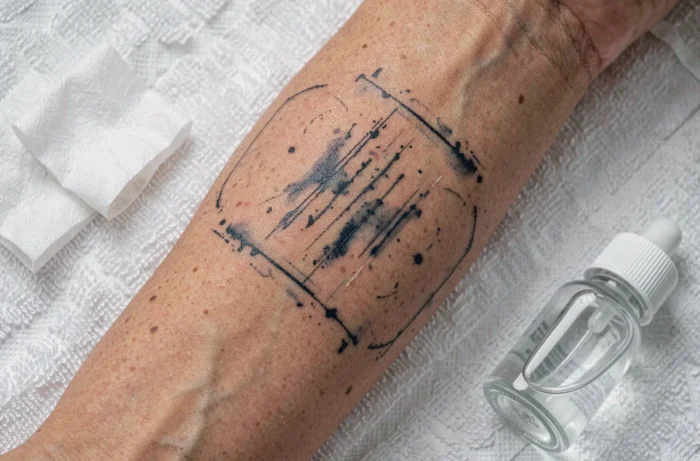
After complete removal, rinse the area with warm water to eliminate any oily residue. Pat dry gently with a clean cloth. If the skin shows slight redness, apply a fragrance-free moisturizer to restore the hydrolipid film.
Products to avoid on a pre-tattoo area
Some methods circulating online pose real risks to the skin, especially if the tattoo is to be done within hours after removing the stencil.
- Isopropyl alcohol: dries out the epidermis and can cause irritation that complicates the tattoo artist’s work. Alcohol alters the skin barrier and promotes inflammatory reactions.
- Heavy oils (tea tree, lavender): despite their reputation, they contain potent allergens. Applying them to weakened skin increases the risk of contact dermatitis.
- Chemical exfoliants (AHA, BHA): they dissolve dead cells but thin the stratum corneum, making the skin more vulnerable to the tattoo needle.
- Acetone or nail polish remover: too aggressive a solvent that can cause chemical burns on reactive skin.
The post-tattoo care guide published by AI for Tattoo in 2026 confirms this approach: fragrances, alcohol, and exfoliants are prohibited during the entire phase when the skin barrier is engaged, whether before or after the session.
Quality of transfer paper and prevention of residues
A stencil that is difficult to remove often indicates a problem upstream. Poor quality hectographic paper deposits more pigment and leaves more stubborn residues.
Professional transfer papers lay down a thin and even layer that erases more easily. Investing in quality paper reduces cleaning time and limits prolonged contact with solvents. If the transfer was done with a thermocopier, the clarity of the copy directly affects the amount of pigment deposited.
Practicing the transfer on synthetic skin before the final application also helps calibrate the pressure and the amount of gel used, two factors that determine the ease of subsequent removal.
Removing a tattoo stencil at home is based on a simple principle: dissolve the lipid film with a neutral fatty substance, let it act, and never scrub. The most effective products are also the most basic, provided to exclude anything containing alcohol or fragrances from the cleaning routine.