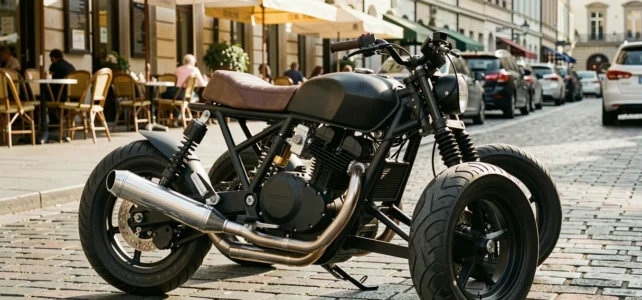
A motorcycle with two rear wheels refers to a motorized vehicle whose rear end has two wheels instead of one. This architecture, found on certain homologated trikes or specific prototypes, profoundly alters the dynamic behavior of the machine, the contact surface with the ground, and the riding sensations.
Geometry of the rear end: what changes with two wheels
On a conventional motorcycle, the single rear wheel transmits power and absorbs braking forces on a single contact patch. With two rear wheels, the contact surface with the ground significantly increases, redistributing the traction and braking forces across two distinct tires.
This configuration also widens the lateral wheelbase. The vehicle gains stability at low speeds and in a straight line, but cornering dynamics follow different rules. The natural leaning that a rider uses to tilt a single-rear-wheel motorcycle is limited by the spacing of the two wheels. Some manufacturers compensate for this constraint with a tilting mechanism, while others accept a behavior closer to that of a quad.
Several enthusiasts explore the two rear wheel motorcycle on Motorcycle Boy to compare the different available architectures and their technical characteristics.
Grip and traction control on a motorcycle with two rear wheels
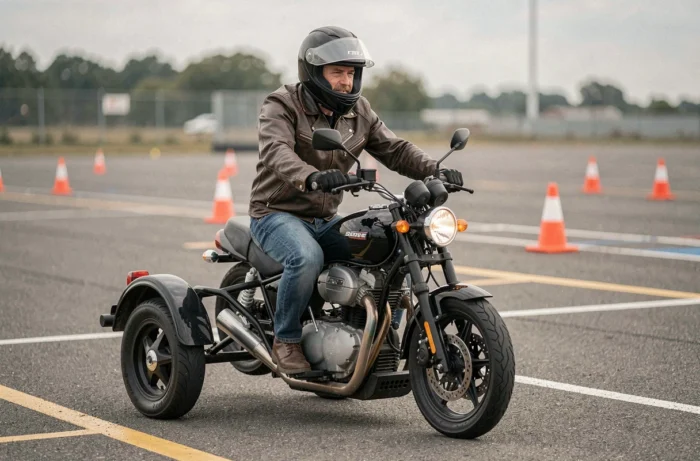
One of the most concrete technical arguments in favor of this configuration concerns grip. Two rear tires provide better traction on wet or degraded surfaces. The load distribution across two contact points reduces the risk of wheel spin during acceleration or corner exit.
Electronic aids focused on rear grip take on a particular dimension on this type of machine. Traction control, which regulates the slip of the driving wheel, must manage two independent wheels or those linked by a differential. According to specialized technical sources, this electronic management remains an active development area, as algorithms designed for a single wheel do not directly apply to a dual configuration.
Rear braking: distribution and modulation
Braking on two rear wheels can be done in two ways. Either a single hydraulic circuit feeds both calipers (coupled braking), or each wheel has its own circuit. The second option offers finer modulation but complicates the system and increases weight.
On the road, the feel at the lever or pedal differs significantly from a conventional motorcycle. Deceleration is more linear, with less risk of sudden locking. For a rider accustomed to finely modulating the rear brake, this gradual response is a tangible advantage in urban riding.
- Coupled braking simplifies use but reduces individual control of each wheel.
- Independent braking allows for precise modulation, useful on mixed surfaces (rain, gravel).
- The addition of a specific ABS for two rear wheels remains a point of technical complexity for manufacturers.
Riding position and passenger accommodation
The width of the rear end modifies the design of the seat and footpegs. On most two rear wheel models, the passenger seat is wider and more stable than on a standard motorcycle. The passenger experiences less lateral movement, reducing fatigue on long journeys.
The rider’s position varies depending on the chosen architecture. On a three-wheeler like the Piaggio MP3 or Yamaha Niken (which have two front wheels), the logic is reversed. On two rear wheel machines, the rider maintains a posture similar to that of a conventional motorcycle, with a slightly lower center of gravity due to the mass distributed over the rear axle.
Luggage and loading: a concrete advantage
The widened rear platform facilitates the installation of saddlebags or a large top case. The increased stability of the rear end better compensates for the asymmetric weight of poorly distributed loads, a flaw that strongly destabilizes a single-rear-wheel motorcycle.
For riders traveling with a bag or camping gear, this configuration offers an additional safety margin during low-speed maneuvers, including parking or U-turns.
Maintenance of rear tires and costs to consider
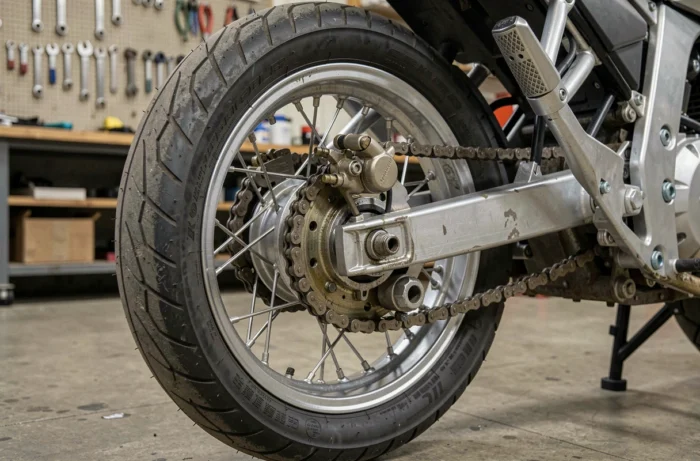
Two rear wheels mean two tires to monitor, replace, and balance. The tire budget mechanically increases compared to a conventional motorcycle. The size of the tires used depends on the model: some adopt standard motorcycle tires, while others use specific, more expensive sizes.
The wear of the two rear tires is not always symmetrical. If the differential or transmission system does not perfectly distribute torque, one tire may wear out faster than the other. Regularly checking the pressure and condition of each tire is a habit to adopt from the first kilometers.
- Check the pressure of both rear tires before each long ride, not just the front tire.
- Monitor for asymmetric wear, a possible sign of a transmission or geometry issue.
- Plan a tire budget that is about one-third higher than that of a single-rear-wheel motorcycle, depending on the sizes.
European regulations are also evolving regarding the end of life for L-category vehicles, which includes two-wheeled and three-wheeled motorized vehicles. New obligations regarding recycling and materials could influence the cost of wear parts in the medium term.
The choice of a motorcycle with two rear wheels is based on a trade-off between stability, traction, and maintenance costs. For urban use with frequent passengers or for loaded trips, the dual rear wheel configuration provides a passive safety that a single wheel cannot match. The compromise comes at the cost of width, weight, and tire budget, three parameters to evaluate based on actual usage.