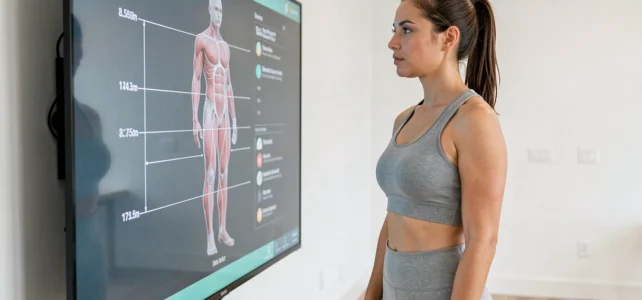
Visualizing one’s body in three dimensions from a few numbers entered into a form: this promise has existed for several years, supported by free online tools and mobile applications. The principle is based on statistical models trained from real body scans, capable of generating an avatar whose proportions adjust to the provided measurements. Bust, waist, hip measurements, height, weight: these data are sufficient to produce a 3D silhouette.
What a 3D avatar generated by measurements really measures
Online body visualizers like BodyVisualizer work by interpolation. A statistical algorithm associates the entered values (height, weight, chest, waist, hip, thigh, and calf circumferences) with a pre-calculated 3D mesh. The result gives a visual approximation of proportions, not a faithful replica of the real body.
The difference between a 3D scan and a parametric avatar lies in the source of the data. A body scanner (booth or application with depth sensor) captures the exact geometry of the body’s surface. An online visualizer, on the other hand, overlays measurements onto a generic model. Posture, local fat distribution, and asymmetries between the right and left sides are not reproduced.
For those looking to see their morphology in 3D with their measurements, these tools offer a useful first visual reference, provided they are not confused with a medical measurement or a usable sewing pattern as is.
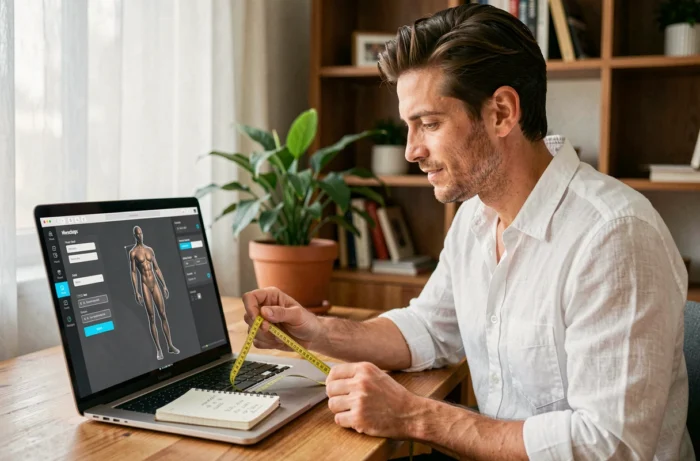
Body scan by smartphone: reliability and limits of mobile applications
In recent years, applications like Nettelo have offered to create a body scan directly from a smartphone. The user stands in front of the camera, strikes two poses, and the application generates a 3D avatar accompanied by an automatic measurement sheet. The process relies on photogrammetry or depth sensors integrated into recent phones.
The differentiated measurements between the right and left sides are among the concrete benefits of these scans, a level of detail impossible to achieve with a standard tape measure. For textile modeling, an avatar from a scan can be imported into simulation software like Clo3D to test a pattern directly on the digitized silhouette.
Field reports vary on the actual accuracy of these applications under domestic conditions. Lighting, distance from the camera, type of clothing worn during the scan, and sensor quality influence the result. A scan performed in a dedicated booth (equipped with calibrated infrared sensors) remains significantly more reliable than a smartphone scan in a living room.
What the scan provides compared to the online visualizer
- The actual geometry of the body is captured, not simply estimated from statistical averages.
- Body asymmetries (shoulders, arms, legs) appear on the model, which is of interest for custom textile work and postural monitoring.
- The avatar can be exported to third-party software (modeling, fitness, medical tracking), whereas an online visualizer only produces a non-usable preview.
3D morphology and self-image: what recent studies say
The psychological aspect of 3D body visualization is starting to be the subject of structured research, particularly in the field of virtual reality. Recent studies show that embodying a 3D avatar that accurately reflects one’s body can, in certain therapeutic protocols, reduce distortions in body perception and dissatisfaction in some individuals.
The benefit is not automatic. Published observations indicate that an avatar perceived as stigmatizing (associated with obesity or a devalued characteristic) can, on the contrary, reinforce negative biases and exacerbate self-stigmatizing attitudes. The context of use – structured therapeutic support or a simple isolated consultation – radically changes the effect produced.
Seeing oneself in 3D is not psychologically neutral. A body visualization tool used without a supportive context can produce very variable effects depending on the individual’s existing relationship with their body.
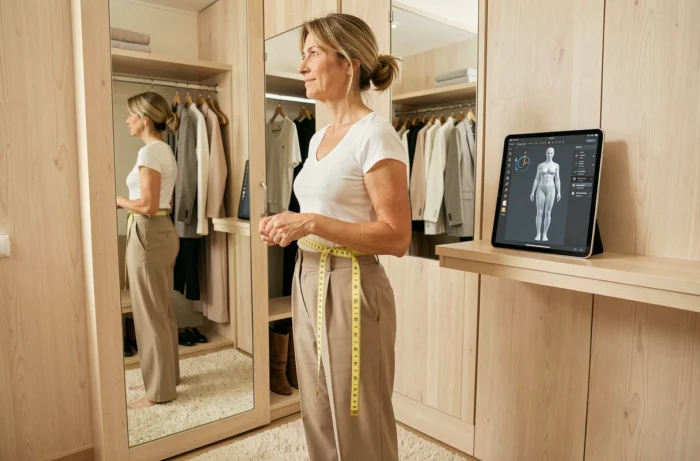
Biometric data and European regulatory framework
Entering one’s measurements into an online tool or getting scanned in 3D involves transmitting bodily data. Since the gradual implementation of the European regulation on artificial intelligence (AI Act), systems processing biometric data are subject to enhanced obligations, particularly when such data allows for the identification or categorization of a person.
The GDPR already classified biometric data among sensitive categories. The AI Act adds a layer of classification by risk level. A simple parametric visualizer that stores nothing on the server does not fall under the same framework as a scanning application that retains the avatar and measurements in a user account.
Points of caution before using a 3D morphology tool
- Check if the entered or scanned data is stored on a remote server or only processed locally in the browser.
- Read the privacy policy regarding the potential sharing of measurements with third parties (e-commerce, insurers, fitness platforms).
- Prefer tools that work without account creation when the goal is a simple one-time visualization.
- 3D body scan data are biometric data in the sense of the GDPR as soon as they allow for identification, which justifies explicit consent.
Visualizing one’s morphology in 3D from measurements remains a tool for self-knowledge, not a diagnosis. Whether using a quick online visualizer or a more precise smartphone scan, the result gains value when it is part of a concrete approach: choosing suitable clothing, tracking body evolution, or working with a health or textile professional.