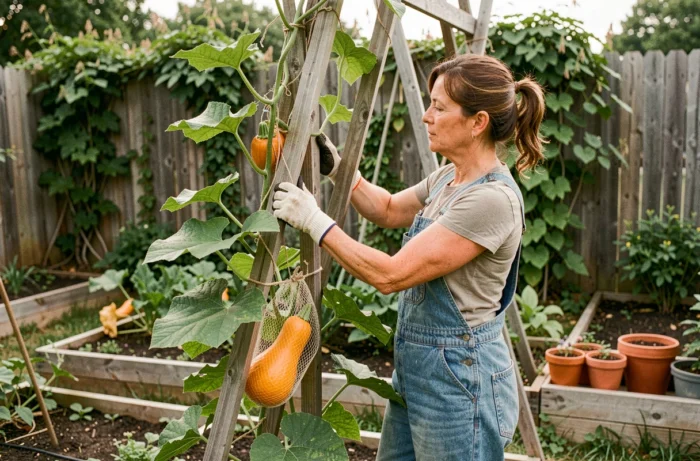
The butternut squash is heavy for a climbing plant. A mature fruit often approaches one kilogram, sometimes more, and the stem that supports it undergoes mechanical stresses that most garden supports are not designed to withstand. Therefore, growing butternut vertically requires solving an engineering problem before discussing gardening.
Mechanical constraints of trellised butternut: weight and wind
The main difficulty is not getting the plant to climb. The butternut naturally produces tendrils that cling to a vertical support. The real issue is what happens when the fruits grow while suspended.
A fruit swaying in the wind exerts torque on the stem, even if the structure remains intact. According to Blooming Expert, a fruit weighing about 4 lb is enough to cause stem cracks due to repeated leverage. The stem does not break all at once: it gradually cracks, interrupting sap flow and compromising fruit maturation.
This phenomenon is exacerbated in exposed gardens. For those who wish to grow butternut vertically, the question of wind must be addressed even before choosing the support. A location sheltered by a wall or hedge significantly reduces oscillations and the risk of cracking.
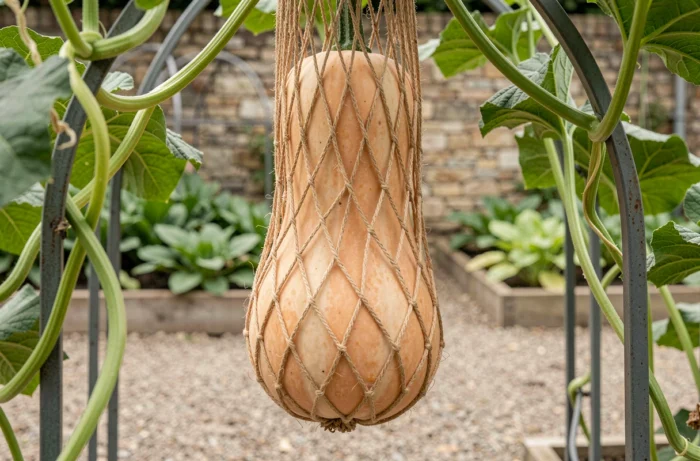
The most reliable solution is to support each fruit individually as soon as it exceeds the size of a tennis ball. Onion netting, used pantyhose, or pieces of fabric tied to the support work like hammocks that transfer the weight to the structure instead of letting it weigh down the stem.
What vertical support for butternut in the vegetable garden
Lightweight wooden trellises sold in garden centers for ornamental plants are not suitable. They are designed to support jasmine or clematis, not several kilos of suspended cucurbits.
Metal arch or galvanized trellis
For a vertically grown butternut, the structure must be considered as a nearly structural element. An article from L’Ami des Jardins details the technical specifications for squash arches:
- Metal or rebar structure, capable of supporting the combined weight of several fruits without excessive bending
- Cladding in large mesh galvanized trellis, allowing hands to pass for harvesting and enabling tendrils to cling
- Feet buried about 40 cm in the ground to ensure stability against the wind
This anchoring depth is often underestimated. A support simply placed on the ground or driven in a few centimeters tips over as the load increases at the end of the season.
Intermediate solution: welded wire panel
A welded wire panel fixed between two sturdy posts offers a good compromise. The rigid mesh supports the weight without deforming, and the cost remains moderate. The ideal height is around two meters, providing enough space for the stems to develop while keeping the fruits accessible.
Soil, water, and fertilizer: adapting fertilization to vertical cultivation
A trellised butternut produces the same root volume and fruit mass as a ground-grown butternut. However, the ground area occupied is much smaller, which concentrates the water and nutrient needs in a restricted area.
The butternut is a greedy plant. A supply of well-decomposed compost at the base, renewed during the season, remains the foundation. Thick mulch around the base limits evaporation and maintains constant moisture in the top few centimeters of soil, where the nourishing roots concentrate.
Watering is the most critical aspect. In vertical cultivation, the foliage receives more wind and sunlight than when on the ground, accelerating evapotranspiration. Regular watering at the base, never on the foliage, prevents powdery mildew while keeping the plant hydrated. A drip irrigation system simplifies this task and avoids water fluctuations that cause fruit splitting.
Vertical butternut yield per square meter
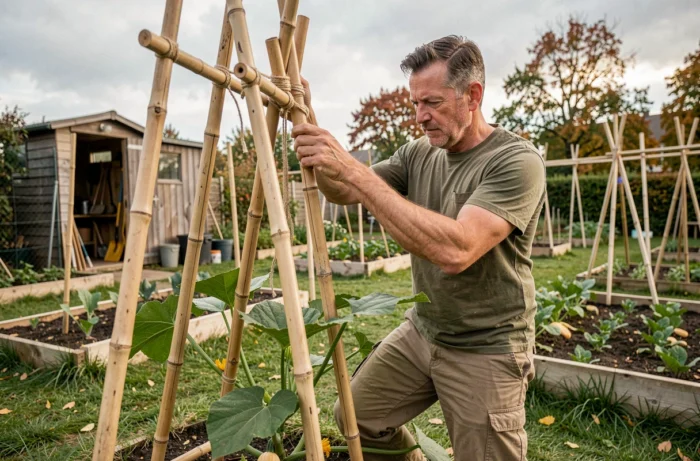
One of the most concrete arguments in favor of vertical cultivation concerns space occupation. According to Le Tribunal du Net, growing butternut vertically can double the yield per square meter compared to traditional ground cultivation. The gain does not come from higher production per plant, but from freeing up ground space for other crops.
A butternut plant left on the ground can easily cover several square meters with its sprawling stems. Trellised, the same plant occupies only about thirty centimeters of width on the ground. The reclaimed space allows for planting salad, radish, or aromatic seedlings at the base of the structure, in the area partially shaded by the foliage.
Field reports vary on the optimal number of fruits to keep per plant in vertical cultivation. Some gardeners prune after two or three fruits to concentrate the plant’s energy and limit the load on the support. Others let the plant regulate itself naturally, even if it means accepting smaller fruits.
Vertical butternut: common mistakes to avoid
Three mistakes consistently appear in the testimonies of gardeners trying vertical cultivation for the first time.
- Installing the support after planting: the roots of the butternut spread quickly, and driving stakes near an established plant damages them. The support should be placed before sowing or planting
- Neglecting trellising at the beginning of growth: young stems must be manually guided towards the support. Without intervention, they default to crawling on the ground and become difficult to redirect once they become woody
- Forgetting fruit hammocks: even with a solid structure, an unsupported fruit pulls on its stem. The hammock should be placed as soon as the fruit starts to weigh, not when it is already large
Growing butternut vertically requires more attentive monitoring than ground cultivation, especially between fruit set and harvest. The support must be checked regularly, ties adjusted, and fruits supported. This extra work is justified in small vegetable gardens, where every square meter counts.