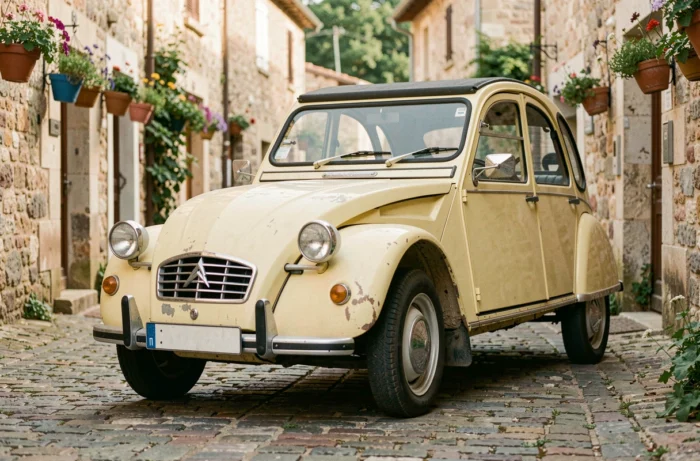
The nickname “Titine” applied to a car relies on a precise linguistic mechanism: hypocoristic formation through syllabic reduplication. Before designating a vehicle, the word circulated in colloquial language as an affectionate diminutive for a person, an animal, or an everyday object. Understanding its transfer to the automobile requires delving into the phonetic and cultural springs that made it so tenacious.
Hypocoristic by reduplication: the linguistic mechanism behind “Titine”
French produces affectionate nicknames through reduplication of the initial syllable, a process that linguistics calls hypocoristic. The same pattern can be observed in “Mimi” (for Marie or Émilie), “Dédé” (for André), “Loulou” (for Louis or Louise). The syllable “ti” reduplicated in “Titine” follows this exact logic.
This type of formation is not random. It favors plosive consonants (t, p, b, d) and closed or mid-closed vowels, which produce a phonetic effect perceived as childlike and tender. The initial “t,” combined with the sharp “i,” creates a clear, short sound that is easy to pronounce, even for a child. It is precisely this phonetic accessibility that explains the longevity of the word.
The suffix “-ine” adds a feminine dimension to the nickname. In French, the feminine ending applied to an object reinforces the idea of personal attachment, which leads us directly to the transfer to the car, a feminine noun in French (“la” voiture). When asking why we call a car titine, the answer lies as much in phonetics as in grammatical gender.
Song of 1914 and the spread of the nickname “Titine” in popular culture
The anchoring of the word in collective memory is facilitated by song. In 1914, the French popular repertoire circulated “Titine” as an affectionate first name in café-concert choruses. The song La Madelon, which would become a trench anthem, explicitly mentions “Titine” as a tender nickname.
This historical context matters. World War I massively disseminated popular songs among millions of soldiers from all regions of France. A word like “Titine,” carried by an easy-to-remember refrain, became embedded in the common vocabulary of an entire generation.
The transfer to the automobile occurred in the interwar period, precisely when the individual car began to spread in French households. The nickname migrated from people to objects through a natural shift: people affectionately named what mattered in their daily lives, and the car took on an increasingly significant role in domestic life.
Charlie Chaplin and the international fixation of the word
Charlie Chaplin’s film Modern Times (1936) features a famous scene where Chaplin sings a pseudo-French gibberish including “Titine.” The song “Je cherche après Titine” had already existed since the 1910s, but the film gave it a global audience. This cinematic exposure solidified the word in the Francophone imagination as a term that is both comical, tender, and popular.
Automobile anthropomorphism: why cars receive a name
Giving a nickname to one’s car is a behavior documented in social psychology: anthropomorphism applied to mechanical objects. The car possesses several characteristics that favor this transfer.
- It has a “face” (headlights, grille) that the human brain spontaneously interprets as a face, activating the neural circuits of facial recognition.
- It emits sounds (engine, horn, rattling) that the owner learns to interpret, creating a perceived form of “dialogue.”
- It accompanies emotionally charged moments (daily commutes, vacations, first dates), which reinforces emotional attachment.
The choice of “Titine” rather than another nickname can be explained by its lexical availability. The word is not attached to any model, brand, or specific era. It functions as a generic nickname applicable to any vehicle, from the 2 CV to the contemporary SUV.
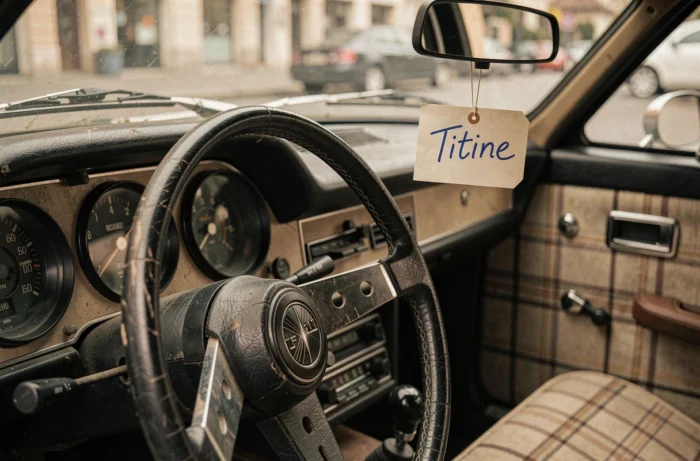
“Titine” in 2025: a nickname still alive or a generational relic?
The French mainstream press continues to use “Titine” as an immediately recognizable reference. Recent articles from TF1 Info and L’Union treat the term as an active nickname, not as an archaism. This retention in everyday vocabulary deserves explanation.
We observe that the word survives because it fulfills a function that alternatives do not cover. Competing nicknames, such as “Choupette,” “Ma Belle,” or personalized creations, remain individual. “Titine” is the only automobile nickname with collective value: every Francophone understands it without context. It functions as a common noun disguised as a first name.
Regional and sociological automobile nicknames
The recent media corpus highlights a diversification of nicknames. Some owners name their cars after their color, brand, or perceived character trait. This variety does not threaten “Titine”: it repositions it as the default nickname, the one used when talking about a car in general rather than one’s own in particular.
The sociological usage is revealing. “Titine” appears more often in a humorous or self-deprecating register (“come on, let’s take Titine”) than in a sentimental register. This light tone ensures a persistence that more sentimental nicknames do not achieve.
The French grammatical gender, a catalyst for the automobile nickname
A factor rarely highlighted in mainstream analyses: grammatical gender plays a structuring role in the practice of automobile nicknames in France. “Voiture” is feminine, “véhicule” is masculine, but it is “voiture” that dominates in everyday language. This feminine form encourages the attribution of feminine first names.
In languages where the equivalent word is masculine or neuter (“car” in English, “Wagen” in German), feminine nicknames exist but do not dominate in the same way. The grammatical feminine of “voiture” has channeled the nickname towards a woman’s first name, and “Titine,” already available in the popular repertoire, has naturally imposed itself.
This convergence between phonetics, grammatical gender, and popular culture explains the stability of the nickname over more than a century. “Titine” was not chosen by an advertiser or imposed by a brand. It is the product of a linguistic and cultural alignment that French, by its very structure, made almost inevitable.