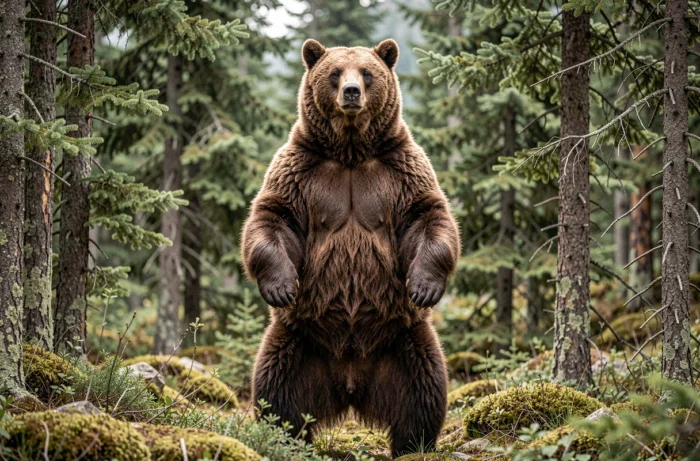
The grizzly and the Kodiak bear belong to the same species, Ursus arctos, but their evolutionary paths have diverged for several thousand years. The island isolation of the Kodiak archipelago in Alaska has produced an ecotype whose measurements consistently exceed those of the continental grizzly. Comparing these two subspecies requires going beyond simple maximum weight measurements to examine seasonal dynamics, dietary habits, and functional morphology.
Seasonal Mass Fluctuation: A Parameter Often Ignored in Comparisons
Displaying a record weight says almost nothing about the actual biology of these bears. The Kodiak can increase its body mass by 20 to 30% between late June and the onset of hibernation, primarily in the form of fat reserves. A photo taken in October and another in May do not show the same animal.
The interior grizzly, less dependent on a concentrated seasonal protein resource, shows more modest variations. Its autumn weight gain exists, but it is spread over a longer period and relies more on berries, roots, and rodents.
We therefore observe a common bias in popular comparisons: the measurements of the Kodiak cited often correspond to males photographed in pre-hibernation, at the peak of their mass. Those of the grizzly come from less standardized surveys. For a detailed article on the size of the grizzly compared to the Kodiak bear, seasonal data must be taken into account to avoid distorting any comparison.
Diet of the Kodiak Bear: Salmon as a Growth Engine
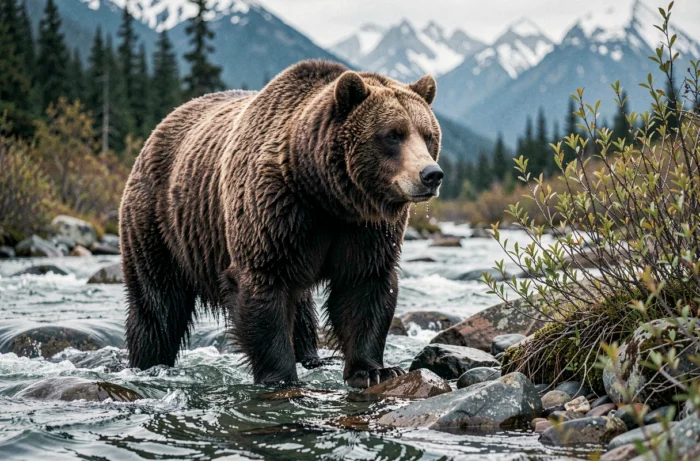
The determining factor for the size difference between these two bears can be summed up in one word: salmon. About 64% of the Kodiak’s diet consists of salmon, compared to a much lower proportion in most populations of continental grizzlies. The remaining 26% is made up of plants and marine invertebrates.
This concentrated protein abundance over a few months (salmon runs in the rivers of the archipelago) allows the Kodiak to accumulate considerable lipid reserves in a short time. The interior grizzly, on the other hand, exploits a broader but less calorie-dense food spectrum over time.
Consequences on Bone and Muscle Structure
A diet rich in marine proteins from a young age does not only result in an excess of fat. Kodiaks develop a more massive skeletal structure, a wider skull, and a proportionally larger dorsal musculature (the characteristic hump) than that of the grizzly.
- The skull of an adult male Kodiak is significantly wider than that of a grizzly of the same age, with more spaced zygomatic arches to anchor powerful chewing muscles.
- The dorsal hump, made up of muscles attached to the spinous processes of the thoracic vertebrae, reaches a greater volume in the Kodiak, giving it increased digging and striking power.
- The front legs of the Kodiak are proportionally thicker, adapted for capturing salmon in strong currents and for physical competition at fishing sites.
Withers Height and Body Length: Measuring at the Right Place
The confusion between withers height and standing height on the hind legs skews most visual comparisons. Withers height is the only reliable standardized measurement for comparing bears, as bipedal posture varies by individual, context, and angle of view.
At the withers, the adult male Kodiak clearly exceeds the average grizzly. Body length (from snout to base of tail) confirms this gap. However, the size difference between a female Kodiak and a male grizzly can be significantly reduced, which side-by-side photo montages never show.
The Trap of Individual Records
Weight records cited on social media almost always concern exceptional males, often weighed after capture under non-reproducible conditions. A “record” Kodiak does not represent the average population any more than a two-meter-ten human represents the average height in France. Population medians are more telling than extremes.
Grizzly and Kodiak: Taxonomy and Genetic Isolation
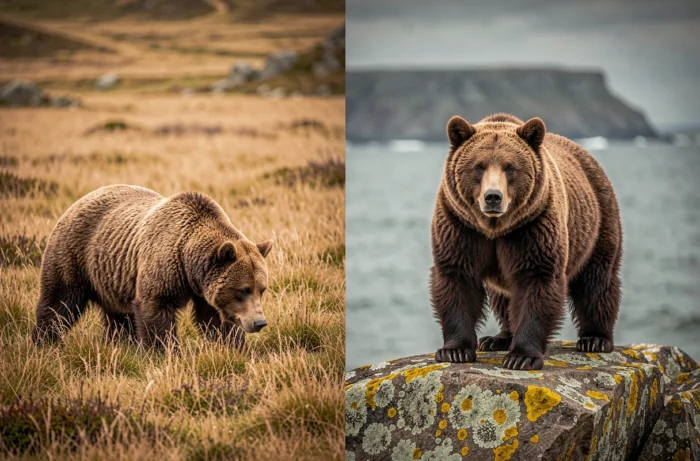
The Kodiak (Ursus arctos middendorffi) has been isolated on the archipelago of the same name since the end of the last glaciation. This geographical isolation, combined with specific dietary selection pressure, has produced marked morphological divergence without constituting a distinct species.
The continental grizzly (often classified as Ursus arctos horribilis) occupies a vast territory, from northern Alaska to the Rockies. This geographical dispersion generates considerable size variability within the subspecies itself. A coastal grizzly from the Alaska Peninsula, which has access to salmon, will be significantly more massive than a grizzly from Yellowstone National Park.
This intraspecific variability makes the “grizzly vs. Kodiak” comparison partially artificial. The diet weighs more than pure genetics on the final size. A coastal grizzly fed on salmon approaches the dimensions of a Kodiak, while an interior grizzly remains significantly smaller.
Polar Bear in the Equation: A Useful Reference Scale
To place the Kodiak and the grizzly in a broader perspective, the polar bear serves as a benchmark. The male polar bear competes with the Kodiak for the title of the largest living terrestrial bear. Their average adult mass largely overlaps.
The fundamental difference lies in morphology. The polar bear has a more elongated body, a proportionally longer neck, and limbs adapted for swimming. The Kodiak, more compact, concentrates its mass on a more compact frame. The grizzly, third in this hierarchy, remains a very imposing animal compared to the North American black bear, which weighs on average two to three times less.
Comparing the grizzly to the Kodiak without mentioning this scale is akin to judging a size difference without a reference point. The grizzly is not “small”: it is the Kodiak that is exceptionally massive, a product of island isolation and an extraordinary food resource.