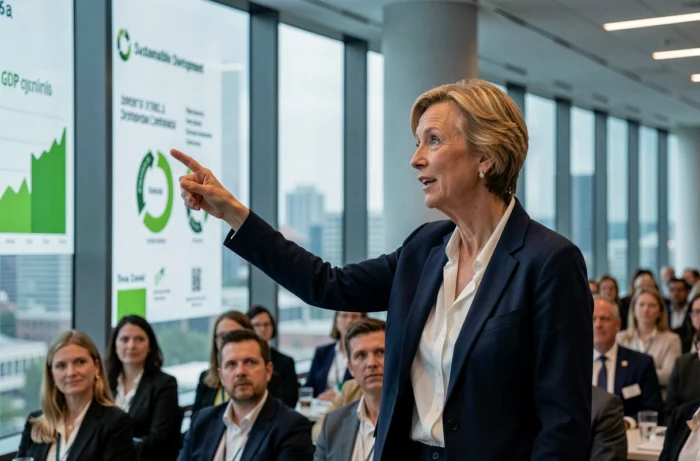
Sustainable growth relies on a bet made at the Rio Summit in 1992: decoupling GDP growth from the consumption of natural resources and fossil fuels. More than three decades later, no country has fully achieved this. Measuring the gap between the ambition of decoupling and economic reality helps to clarify what this concept truly entails and why it is crucial for the stability of the global economy.
Decoupling GDP and natural resources: where do we really stand
The principle is simple to state: grow wealth produced without proportionally increasing pressure on the environment. In practice, the trajectory remains disappointing.
Decoupling can be relative (resource consumption grows less quickly than GDP) or absolute (GDP increases while resource consumption decreases). Most industrialized economies have only achieved relative decoupling, which is insufficient to respect planetary boundaries.
| Type of decoupling | Definition | Observed situation |
|---|---|---|
| Relative | Resource consumption grows less quickly than GDP | Achieved in several industrialized countries |
| Absolute | GDP grows while resource consumption declines | No country has achieved this sustainably and globally |
This table summarizes the gap between the goal set in Rio and reality. Green growth, as currently pursued, has not yet proven that it can work on a macroeconomic scale without transferring pollution to other territories.
To better understand the definition of sustainable growth, it is essential to keep in mind this distinction between relative and absolute decoupling: it conditions any serious evaluation of current economic policies.
Biodiversity loss and macroeconomic risk: an underestimated angle
Debates on sustainable growth often focus on greenhouse gas emissions and energy consumption. Biodiversity occupies a secondary place in public discourse. Recent data overturns this hierarchy.
The IUCN indicates that more than half of global GDP is threatened by nature loss. This figure shifts the topic: biodiversity is no longer a peripheral issue reserved for environmentalists, but an economic stability factor on par with access to capital or inflation control.
The most exposed sectors are those that directly depend on ecosystem services: agriculture, fishing, tourism, extractive industries. When an ecosystem collapses, supply chains weaken, insurance costs rise, and a territory’s productive capacity declines.
- Pollinators support a significant share of global food production, and their decline directly affects agricultural yields.
- Soil degradation reduces the productivity of arable land, forcing increasing investments to maintain production volumes.
- The destruction of mangroves and coral reefs removes natural barriers against coastal disasters, increasing economic losses related to climate events.
Integrating biodiversity into the calculation of sustainable growth is therefore not an ethical choice. It is a condition for economic resilience that traditional indicators like GDP do not capture.
Financing the SDGs and global financial architecture
Sustainable growth requires massive investments in energy transition, resilient infrastructure, and human development. The UN highlights in 2026 a massive financing gap for sustainable development goals, particularly in developing countries.
This gap shifts the debate. The question is no longer just how to produce differently, but how to direct financial flows to the territories and sectors that need them most. Private capital remains concentrated in already industrialized economies, where returns are perceived as safer.
Weak sustainability versus strong sustainability
Two visions clash on how to finance and conceive this transition. Weak sustainability holds that destroyed natural capital can be compensated by technological or financial capital. Strong sustainability asserts that certain natural resources are irreplaceable and that their destruction leads to permanent losses.
However, in both frameworks, the observation is shared: without reforming the global financial architecture, the least developed countries will not be able to finance their transition. The financing gap creates a vicious cycle where vulnerable economies suffer the effects of climate change without the means to adapt.

Business resilience and value chains in the face of shocks
Sustainable growth is not limited to public policies. For businesses, it involves rethinking the robustness of their business models in the face of climate, geopolitical, and energy shocks.
Several recent analyses now distinguish sustainability from mere carbon footprint reduction. Value chain resilience is becoming an autonomous pillar: a company can show a declining carbon balance while remaining vulnerable to supply disruptions or a regional energy crisis.
CSR, framed notably by the ISO 26000 standard, provides a framework for structuring this reflection. It covers the environment, governance, working conditions, and contribution to local development. However, its adoption remains uneven across sectors and company sizes.
- Large companies are publishing increasingly detailed environmental reports, under regulatory and shareholder pressure.
- SMEs often lack the resources to conduct a comprehensive assessment of their exposure to climate risks.
- Globalized value chains create interdependencies that make each link vulnerable to disruptions experienced by others.
The transition to sustainable growth also depends on companies’ ability to anticipate these vulnerabilities rather than react afterward.
The absolute decoupling between GDP and resource consumption remains the decisive test. As long as it is not achieved, sustainable growth remains a work in progress, not an accomplishment. The loss of biodiversity, the financing gap for the SDGs, and the fragility of value chains show that the stakes far exceed the energy question alone.