
In most French markets, the price per square meter of an apartment exceeds that of a comparably located house. This observation, often attributed to urban density and the scarcity of land in city centers, is actually based on a broader set of causes. Recent regulatory and financial mechanisms exacerbate this gap, sometimes more than just the pressure of demand in tight areas.
PTZ and differentiated quota: a structural advantage for new apartments
The zero-interest loan treats collective purchases differently than individual houses. In new collective housing, the maximum quota of the PTZ reaches 50%, compared to 30% for a new individual house in the most favorable bracket. This asymmetry is not trivial: it directly increases the borrowing capacity of households opting for an apartment.
A first-time buyer financing a significant part of their purchase with a zero-interest loan can absorb a higher listed price while maintaining an affordable monthly payment. This surplus purchasing power impacts selling prices, as explained by the Experts Immobilier website in its analysis of the disparities between types of properties.
Developers incorporate this data into their pricing structure, which supports the prices of new apartments without rental demand or land scarcity being the primary cause. This regulatory bias often goes unnoticed in public comparisons, which focus on the gross price per square meter without factoring in the actual financing conditions.

DPE and thermal sieves: a stronger discount on houses
Energy performance now plays a significant role in property price formation. Recent notarial data shows that the discount related to a poor DPE is more pronounced for houses than for apartments. A house rated F or G suffers a proportionally greater loss of value than an apartment in the same situation.
Several factors explain this asymmetry:
- Individual houses have a much larger thermal loss surface area (roof, walls, ground floor) than an apartment located between two heated units.
- The cost of energy renovation for a house generally exceeds that of an apartment, resulting in a more aggressive discount upon resale.
- The gradual prohibition of renting thermal sieves affects the stock of older houses more, reducing their attractiveness to investors.
This phenomenon creates a scissors effect: apartments, which are easier to insulate and often better rated due to vertical adjacency, maintain their value. Energy-intensive houses, on the other hand, see their relative prices decline. The price gap between the two types of properties is mechanically widened.
Resale market and resilience of spacious apartments
The behavior of the new market varies according to the size and type of housing. Recent data indicates that spacious apartments hold their prices better than large houses. This discrepancy is particularly observed in the provinces, where the supply of new houses remains significant.
The demand for large apartments in the city (four rooms and more) is supported by buyers seeking space without the maintenance burdens of a house. Garden, roof, facade: these expense items weigh on the budgets of homeowners and reduce the price a buyer is willing to pay.
The weight of condominium fees in the calculation
It is often argued that condominium fees increase the actual cost of an apartment. This is true in operation, but it does not directly affect the listed purchase price. Buyers primarily consider the price per square meter and their borrowing capacity, not the total cost of ownership over ten years.
In contrast, houses incur non-shared maintenance costs (facade renovation, roofing, individual sanitation) that, if included in a budget forecast, would often exceed the annual amount of condominium fees for an equivalent apartment. The listed price of a house conceals ownership costs that the apartment shares.
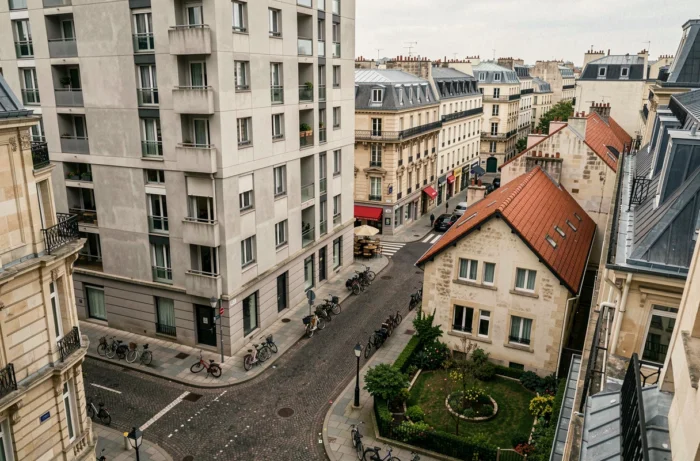
Location and real estate prices: beyond the downtown reflex
The scarcity of land in dense areas remains a price factor for apartments, but this classic mechanism is no longer sufficient to explain the entire gap. In medium-sized cities like Montpellier or in Languedoc-Roussillon, transactions reveal price per square meter that can sometimes be comparable between downtown apartments and first-ring houses.
What truly differentiates the two markets is liquidity. A well-located apartment sells faster than a house at an equivalent price because the pool of potential buyers is broader: first-time buyers aided by the PTZ, rental investors, retirees seeking convenience. The superior liquidity of the apartment supports its price independently.
Houses, on the other hand, cater to a more limited buyer profile: families with children, often dependent on traditional credit, sensitive to transportation and maintenance costs. This segmentation reduces competitive pressure in the housing market and limits price increases.
Regulation, financing, energy: three levers that widen the gap
The analysis of real estate prices by property type can no longer be reduced to location and surface area. Financing mechanisms (PTZ with differentiated quotas), energy constraints (DPE, prohibition of renting thermal sieves), and the resilience of spacious apartments in the new market form a regulatory and financial triptych that structurally advantages apartments.
Regulatory factors now weigh as heavily as urban scarcity in price formation. This recent trend could intensify if DPE thresholds tighten or if PTZ conditions evolve. Buyers comparing houses and apartments should consider these parameters in their calculations, beyond just the listed price per square meter.