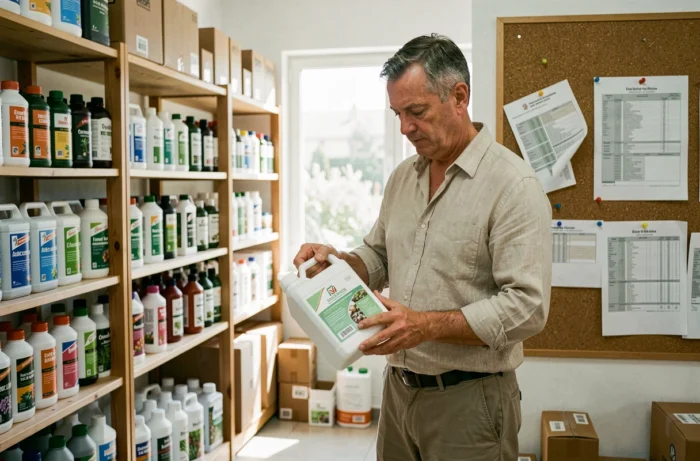
Glyphosate remains the most sold herbicide in the world, including in Portugal where its regulatory framework has significantly evolved in recent years. The amendment of decree-law no. 101/2009 introduced a clear separation between professional and domestic use, radically changing the purchasing conditions according to the buyer’s profile. Before placing an order from abroad or on-site, several checks are necessary to avoid non-compliant acquisition.
Amended decree-law no. 101/2009: what the Portuguese text actually allows
The Portuguese legal framework is based on decree-law no. 101/2009, amended to align national legislation with European regulation (EU) 2023/2660, which renewed the authorization of glyphosate in the European Union. The text distinguishes two categories of users.
For agricultural professionals with a valid phytosanitary certification, the purchase and application of glyphosate-based products remain legal. Vineyards in Alentejo or olive groves in Trás-os-Montes continue to use it as part of regulated weeding programs.
On the other hand, the sale of glyphosate to individuals for domestic use is prohibited in Portugal. This restriction applies to both physical garden centers and Portuguese online sales sites. A French individual attempting to order a canister of glyphosate 360 from an online Portuguese distributor would therefore encounter this regulatory barrier, unless they can justify a recognized professional status.
Before any action, it is essential to verify that the seller indeed requires proof of professional qualification. A site that ships without asking about the buyer’s status operates outside the legal framework in Portugal. For those wishing to buy glyphosate in Portugal legally, this verification serves as the first reliability filter.
Glyphosate and importation to France: concrete legal risks
Even if a product is purchased legally in Portugal with a valid professional status, its importation to France poses a distinct problem. France has prohibited the sale of glyphosate to individuals since 2019 and severely restricts its professional use. Importing a non-approved phytosanitary product into France exposes one to criminal penalties.
Investigations conducted by the French Office for Biodiversity (OFB) have highlighted regular trafficking of phytosanitary products purchased in the Iberian Peninsula and resold in France via platforms like eBay or Rakuten. Convictions have been handed down against resellers who shipped canisters of glyphosate from Spain or Portugal to French individuals.
The purchased product must correspond to a marketing authorization (MA) issued by the National Health Security Agency (Anses) to be used legally on French territory. A glyphosate 360 approved in Portugal under a local brand does not automatically have this French MA.
Checks before ordering
- Verify that the product is listed in the Anses e-phy database, which catalogs all valid MAs in France
- Ensure that the Portuguese seller requires proof of phytosanitary certification (Certiphyto or recognized equivalent European certification)
- Check that the product labeling includes the mandatory mentions in the language of the country of use, in accordance with the European CLP regulation
- Confirm that the indicated concentration (often 360 g/L) corresponds to the authorized formulation and not to a counterfeit or overdosed product
Portuguese regulatory situation in 2024-2025: municipalities and exceptions
Portugal has a peculiarity: the coexistence of contradictory local policies. The city of Porto has banned glyphosate from its public spaces. The Autonomous Region of the Azores has adopted regional legislative decree no. 28/2020/A to prohibit its use in the public spaces of the archipelago.
Despite these local initiatives, a partial return of glyphosate in certain Portuguese public spaces was observed at the end of 2024. Some municipalities have reintroduced the herbicide on an exceptional basis, arguing the lack of a cost-effective alternative for maintaining road and rail infrastructure.
This regulatory mosaic complicates the situation for a foreign buyer. A product available in an agricultural cooperative in the Algarve may be prohibited for use in public spaces just a few kilometers away, in a neighboring municipality that has adopted a zero-pesticide policy.
Glyphosate sales in the European Union: the paradox of volumes
The European context sheds light on the Portuguese situation. Despite political rhetoric on reducing pesticides and the goals set by the Farm to Fork strategy, glyphosate sales in the European Union have increased by more than 44% between 2015 and 2024. This gap between regulatory ambitions and commercial reality partly explains why the market remains so active in southern European countries.
Portugal, Spain, and Italy constitute markets where professional agricultural demand maintains high sales volumes. Portuguese agricultural cooperatives offer packaging suitable for medium-sized farms, with prices generally lower than those in Northern Europe.
For a professional French buyer, the question is therefore not so much the availability of the product in Portugal as its compliance with the French framework upon arrival. A glyphosate purchased legally in Lisbon becomes an illicit product as soon as it crosses the border without a valid French MA.
Concentration and formulation: distinguishing acid glyphosate and salt
Products sold in Portugal display varied concentrations. The most common formulation, glyphosate 360, contains 360 grams of active substance per liter in the form of isopropylamine salt. Other more concentrated formulations exist on the Iberian market.
The concentration of equivalent acid glyphosate is the only reliable indicator for comparing two products. A canister labeled “450 g/L” may contain less actual active substance than a “360 g/L” if the chemical form differs. The label must indicate the content of equivalent acid, not just the salt content.
A counterfeit or artisanally reformulated product presents increased health and environmental risks. Seizures carried out by French customs and the OFB have revealed canisters whose actual composition did not match the labeling, with unauthorized additives in Europe.
The Portuguese glyphosate market remains accessible to qualified professionals, but each step of the purchasing chain deserves rigorous verification. The product’s compliance, the buyer’s status, and the legality of importation into the destination country form three distinct filters that no online purchasing convenience exempts from verification.